Showing posts with label Temples. Show all posts

Wednesday, December 24, 2008

Cathedral of Santa Eulalia

The Cathedral of Santa Eulalia (also called La Seu) is the Gothic cathedral seat of the Archbishop of Barcelona, Spain. The cathedral was constructed throughout the 13th to 15th centuries on top of a former Visigothic church. The neo-Gothic façade is from the 19th century.

The cathedral is dedicated to Eulalia of Barcelona, co-patron saint of Barcelona, a young virgin who, according to Catholic tradition, suffered martyrdom during Roman times in Barcelona. One story is that she was exposed naked in the public square and a miraculous snowfall in mid-spring covered her nudity. The enraged Romans put her into a barrel with knives stuck into it and rolled it down a street (according to tradition, the one now called 'Baixada de Santa Eulalia'). The body of Saint Eulalia is entombed in the cathedral's crypt.
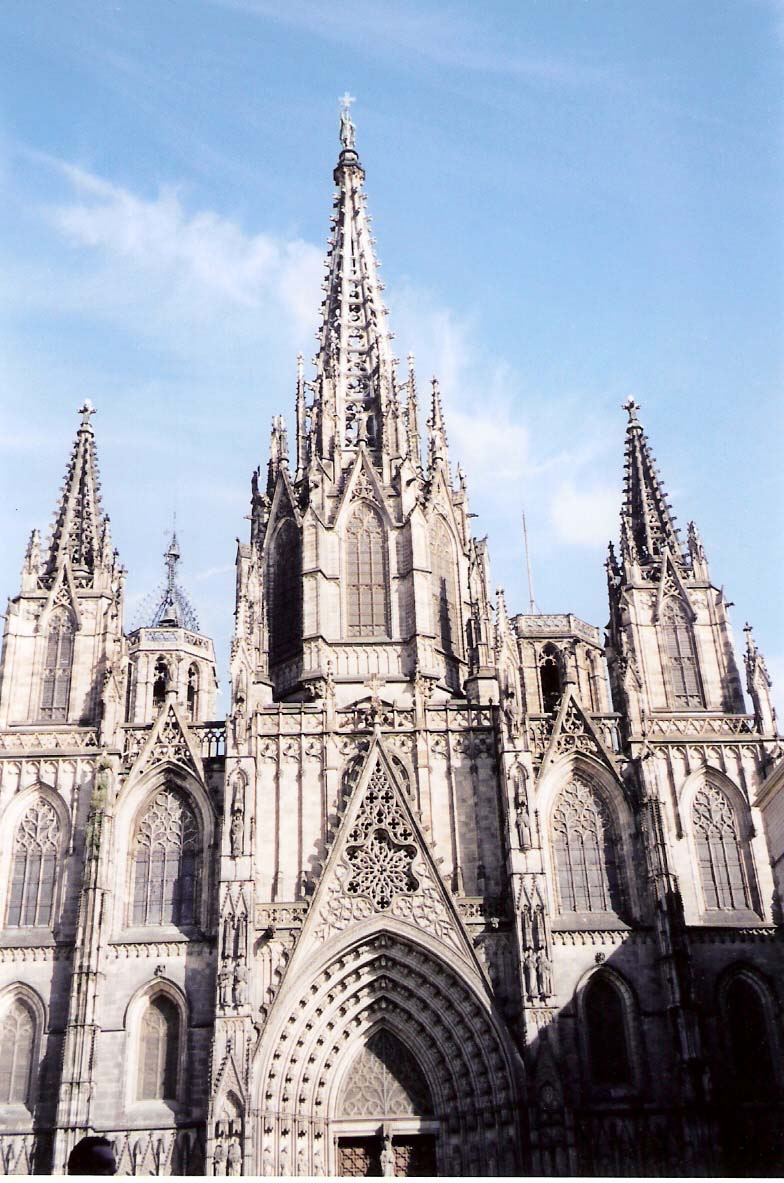
Photo by Travis S.

Already in 343 A.D. during the Roman Empire a basilica was built at the site of the current cathedral. In 985 the basilica was destroyed by the Moors, led by Al-Mansur. It was replaced by a Roman cathedral, built between 1046 and 1058. A Roman chapel, the Capella de Santa Llucia, was added between 1257 and 1268. It was later incorporated in the cloister next to the cathedral. 30 Years later, in 1298, construction of the gothic cathedral started under King Jaume II, known as 'the Just'. During the construction of the gothic cathedral, the existing roman building was demolished except for the Santa Llucia chapel.

Due to civil wars and the black death which hit the city several times, the construction only progressed slowly. It took until 1460 before the main building was completed. The gothic facade was finished much later, in 1889 and the last part, the central spire, was completed in 1913. The design of both the facade and the spire were based on the original design from 1408 by the French architect Charles Galters.
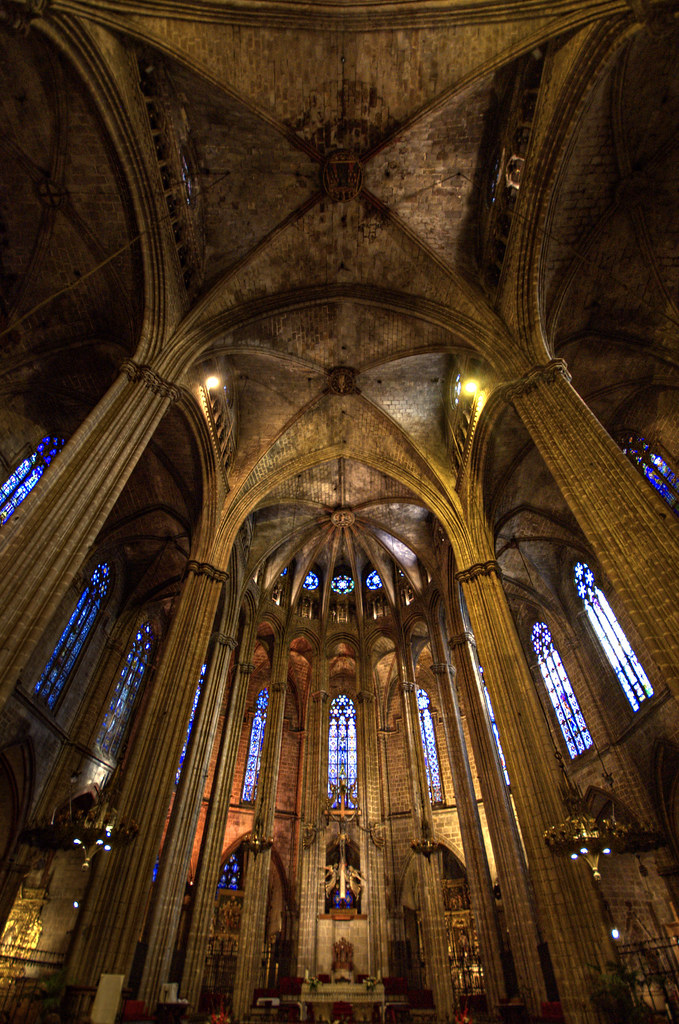
Photo by aragost


The church is 93m/305ft long and 40m wide. The octagonal clock towers reach a height of more than 50m. They were built between 1386 and 1393. The spire of the central tower reaches a height of 70m or 230ft.The interior consists of one wide nave with 28 side chapels. The crypt contains the sarcophagus of Santa Eulalia. The cathedral also has a beautifully carved choir. A lift in the northeast of the cathedral brings you to the top of the roof of the cathedral.

Adjacent to the cathedral is a 14th century cloister. There are always 13 geese in its central courtyard. Each goose represents one year in the life of the martyr Santa Eulalia, a young girl tortured to death in the 4th century by the Romans for her religion. The cloister also contains a small museum with liturgist artifacts.
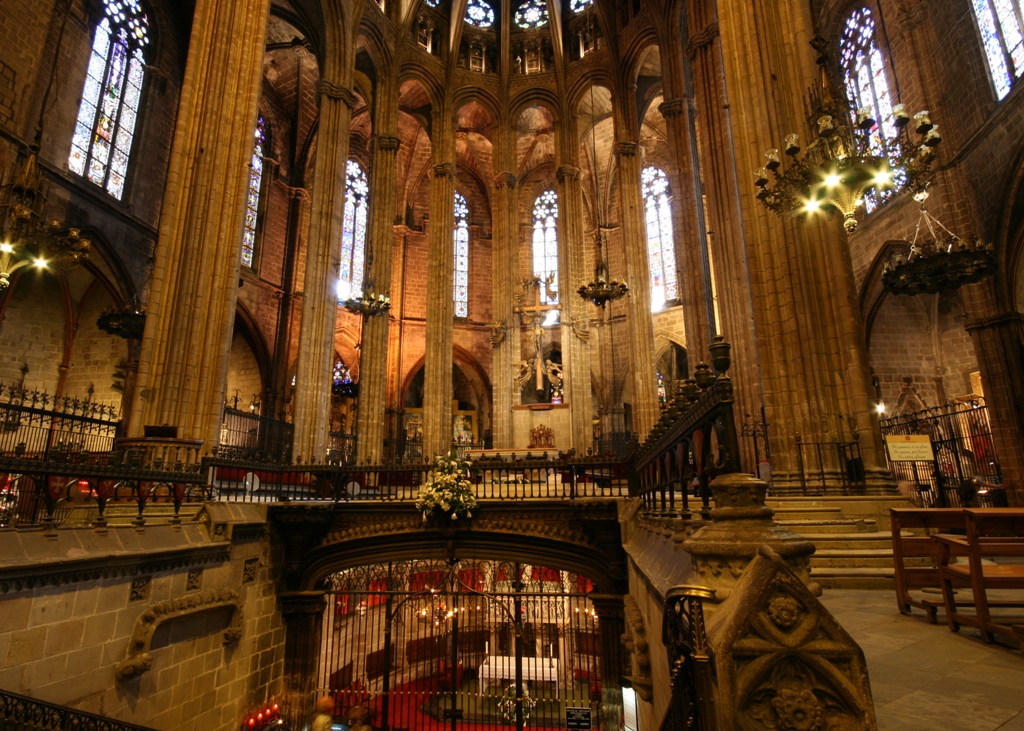


One side chapel is dedicated to "Christ of Lepanto", and contains a cross from a ship that fought at the Battle of Lepanto (1571). The body of the cross is shifted to the right. Catalan legend says that the body swerved to avoid being hit by a cannonball. This is believed to have been a sign from God that the Ottomans would be defeated. The cathedral has a secluded Gothic cloister where thirteen white geese are kept (it is said that Eulalia was 13 when she was murdered).

Read more...

Tuesday, December 16, 2008

Taj mahal

Taj Mahal, a mausoleum in Agra, India, regarded as one of the most beautiful buildings in the world. The Mughal emperor Shah Jahan had it built in memory of his wife, Arjumand Banu Bagam, known as Mumtaz Mahal (Persian for “Elect of the Palace”), who died in 1631.

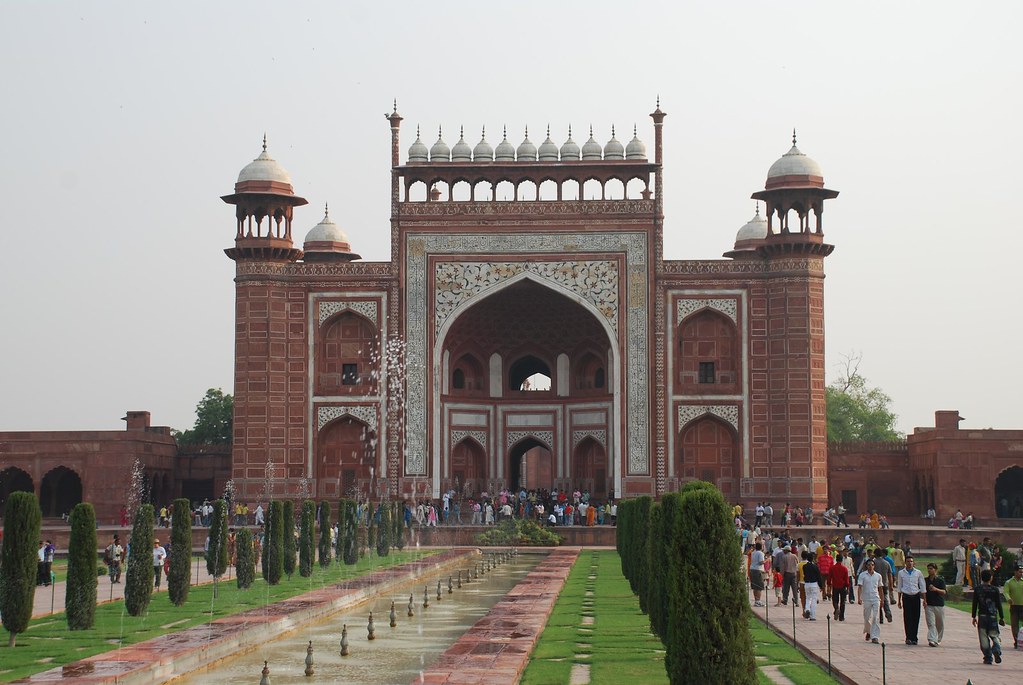
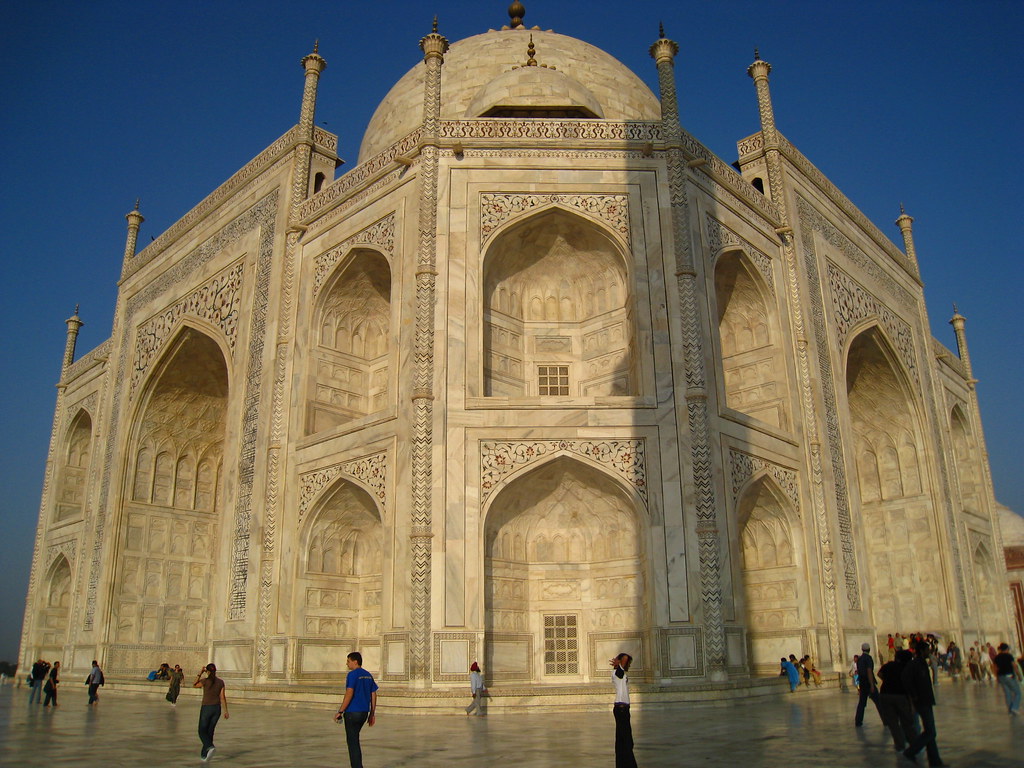
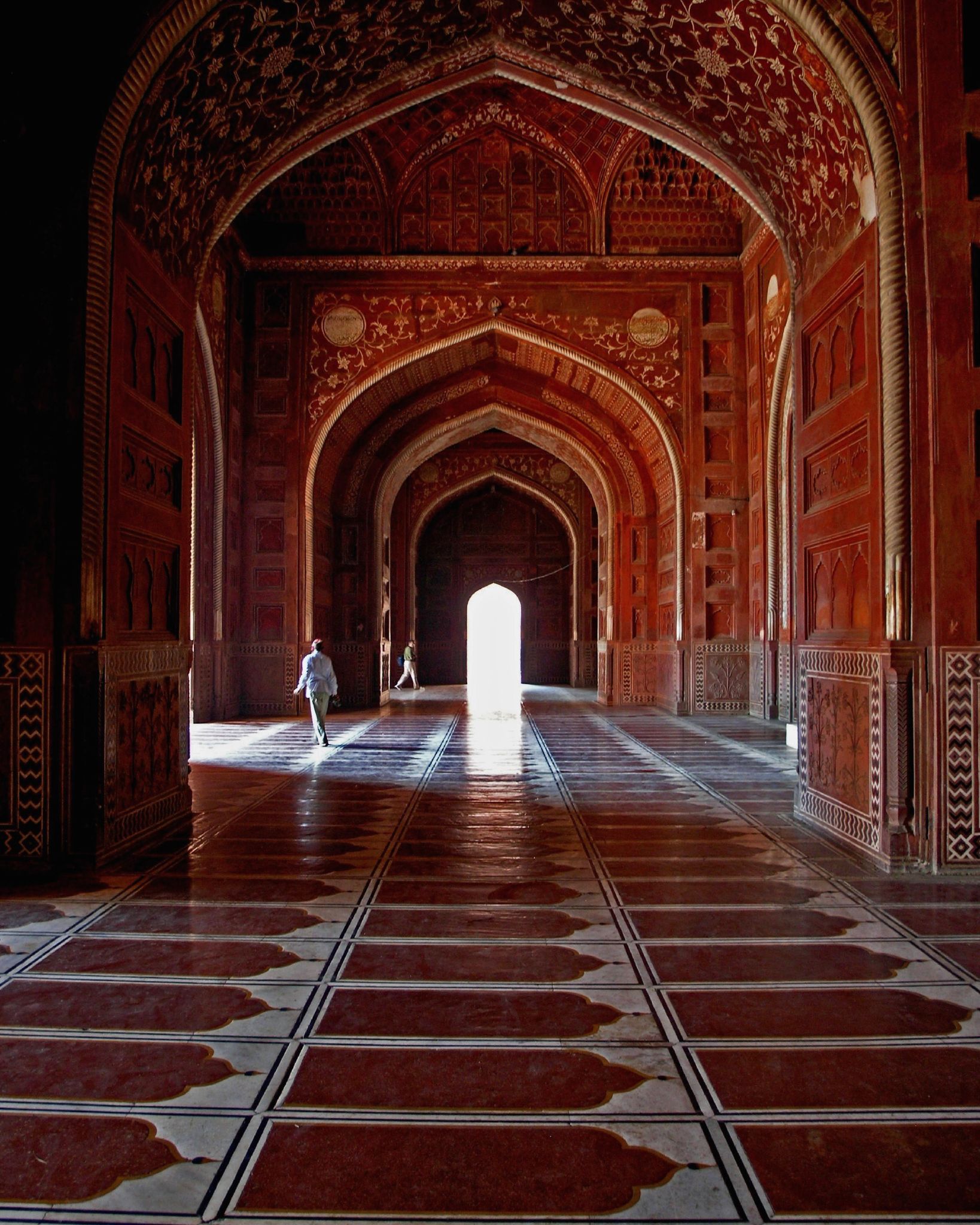
Building commenced about 1632. The mausoleum was complete by about 1643 and the surrounding complex of buildings and gardens was complete by about 1653. Situated on the southern bank of the Yamuna River, the white marble mausoleum is composed of four identical facades, each containing a large central arch 33 m (108 ft) high. A large bulb-shaped dome, over 73 m (240 ft) tall, rises over the center, with four smaller domes surrounding it. The building is raised on a square podium with a minaret (tower) at each corner. It is flanked by two red sandstone buildings—a mosque and its replica, the Jawab (Answer), a building of which the main function is visual balance. Visitors approach the Taj Mahal through an imposing red sandstone gate, decorated with inscriptions from the Muslim holy book, the Qur'an (Koran).

The gate and accompanying walls also contain a vast, geometrically laid out garden, 305 m (1,002 ft) on each side. The enclosed garden, itself a Muslim symbol of paradise, is centered on a large, raised pool. Canals divide it into four equal parts, each containing flower beds, fountains, and cypress trees (symbols of death).


Inside the Taj Mahal, the tomb of Mumtaz Mahal stands at the center of an octagonal hall, while the slightly larger tomb of Shah Jahan, who died in 1666, is off to one side. Both are elaborately carved and inlaid with semiprecious stones, illuminated by sunlight filtering through an elaborately carved marble screen that is also studded with jewels.

The construction of Taj Mahal started in the year 1631 and it took approximately 22 years to build it. An epitome of love, it made use of the services of 22,000 laborers and 1,000 elephants. It was built entirely out of white marble, which was brought in from all over India and central Asia. After an expenditure of approximately 32 million rupees (approx US $68000), Taj Mahal was finally completed in the year 1653. However, the history of Taj Mahal of India still has some gaps. For example, there are many theories regarding the architect of this magnificent monument.

Shah Jahan met Mumtaz Mahal and fell in love. He married her after five years and they were leading a very happy life. While giving birth to their last child, Mumtaz Mahal died due to some complications. A few years later Shah Jahan built the world's most beautiful monument "Taj Mahal" in the memory of his wife.


Photo by Brajeshwar

One of the wonders of the world "Taj Mahal" has a beautiful love story behind its construction. Taj Mahal love story is about Shah Jahan and Mumtaz Mahal. Shah Jahan, initially named Prince Khurram, took birth in the year 1592. The son of Jehangir, the fourth Mughal emperor of India, he fell in love in Arjumand Banu Begum at first time. At that time he was 14 years old and she, a Muslim Persian princess, was 15. After meeting her, Shah Jahan went back to his father and declared that he wanted to marry her. Read on to know more about the love story behind Taj Mahal of Agra…

The match got solemnized after five years i.e., in the year 1612. Shah Jahan became the Emperor in the year 1628 and entrusted Arjumand Banu with the royal seal. He also bestowed her with the tile of Mumtaz Mahal, meaning the "Jewel of the Palace". Though Shah Jahan had other wives also, but, Mumtaz Mahal was his favorite and accompanied him everywhere, even on military campaigns. In the year 1631, when Mumtaz Mahal was giving birth to their 14th child, she died due to some complications.

It is said that Shah Mahal was so heartbroken after her death that he ordered the court into morning for two years. Some time after her death, Shah Jahan undertook the task of erecting the world's most beautiful monument in the memory of his beloved. It took 22 years and the labor of 22,000 workers to construct the monument, which is also said to be the last wish of Mumtaz Mahal. This magnificent monument came to be known as "Taj Mahal" and now counts amongst the Seven Wonders of the World.

Photo by werner boehm

Taj Mahal architecture is a kind of fusion of Persian, Central Asian and Islamic architecture. The main gateway, with its domed central chamber, is situated at the end of the long watercourse. On one side of the Taj Mahal is the Mosque and on the other, the Naqqar Khana, built mainly to maintain its symmetry. The main building, that of the Taj itself, stands on a raised, square platform with its four abridged corners, forming an unequal octagon. The architecture of Taj Mahal of Agra has made use of the interlocking arabesque concept. As per this concept, each element maintains its own identity and yet perfectly merges with the main structure. The principles of self-replicating geometry, along with symmetry of architectural elements are also seen in the design and layout of Taj Mahal. The four 162.5 feet minarets have been consciously shortened a bit to emphasize the faintly spherical dome. The central dome, 58 feet in diameter and 213 feet in height, stand bordered with four subsidiary domed chambers.

A shadowy burial crypt inside the Taj Mahal houses the tombs of Shah Jahan and his wife Mumtaz Mahal. Above these tombs is the main chamber that has the false tombs, typical of mausoleums of the Mughals. Perforated marble screens were used to transmit light into the central chamber. A major irony behind Taj Mahal is that the man who got this magnificent monument built is himself responsible for disturbing its symmetry. His tomb, which lies next to that of Mumtaz Mahal, was never planned and deranges Taj's interior.

Photo by betta design

Just opposite to the mosque in Taj Mahal i.e., on the eastern side of the Taj is a monument that is known to be a twin of the mosque. This red sandstone monument is called Taj Mahal Naqqar Khana or the Rest house or Jawab (Answer) and is faced away from the Mecca. It is built exactly like the mosque of Taj Mahal. However, it was never used for prayer purposes. Infact, till today the purpose of building the rest house in Taj Mahal, of Agra, is not known.

However, some people believe that it was constructed to conserve the symmetry of Taj Mahal. Beautiful flower designs and other decoration, in white marble, adorn the Taj Mahal Naqqar Khana. The floor between this monument and the mosque also reflects a full size reproduction of the pinnacle embellishing the Taj Mahal.

The architects planned water devices at the Taj Mahal in a very systematical manner. The water for Taj Mahal was drawn from the river and came from a number of underground pipes. Purs (a rope and bucket pulled by bullocks) were used for drawing water from the river and from there the water was transferred to a huge storage tank. Again thirteen purs were used to pump the water from the tank. From this tank, the water was taken into another huge storage tank through an over-head water-channel.

From this tank, water was again pumped through fourteen purs and finally filled into three supply tanks through another channel. The last one of the supply tanks had pipe mouths in its eastern wall. These pipes entered the Taj Mahal enclosure from underground, with one of them moving towards the mosque to supply the fountains there. For the fountains in the north-south canal and the lotus pond and its canal, copper pipes were used.

To ensure uniform and undiminished water pressure in the fountains, a copper pot was provided under each fountain pipe. The water supply came first into the pot only and from there rose simultaneously in the fountains. However, the main supply of the water in these pots came through earthenware pipes. Most of the water devices at Taj Mahal have stood the test of time and are still present there.


Year of Construction: 1631
Completed In: 1653
Time Taken: 22 years
Built By: Shah Jahan
Dedicated to: Mumtaz Mahal (Arjumand Bano Begum), the wife of Shah Jahan
Location: Agra (Uttar Pradesh)
Building Type: Islamic tomb
Architecture: Islamic
Cost of Construction: 32 crore rupees
Number of workers: 20,000
Highlights: One of the Seven Wonders of the World.


Photo by voobie

Read more...

  © Blogger template Psi by Ourblogtemplates.com 2008

Back to TOP