Showing posts with label Buildings. Show all posts

Tuesday, December 16, 2008

Turning Torso

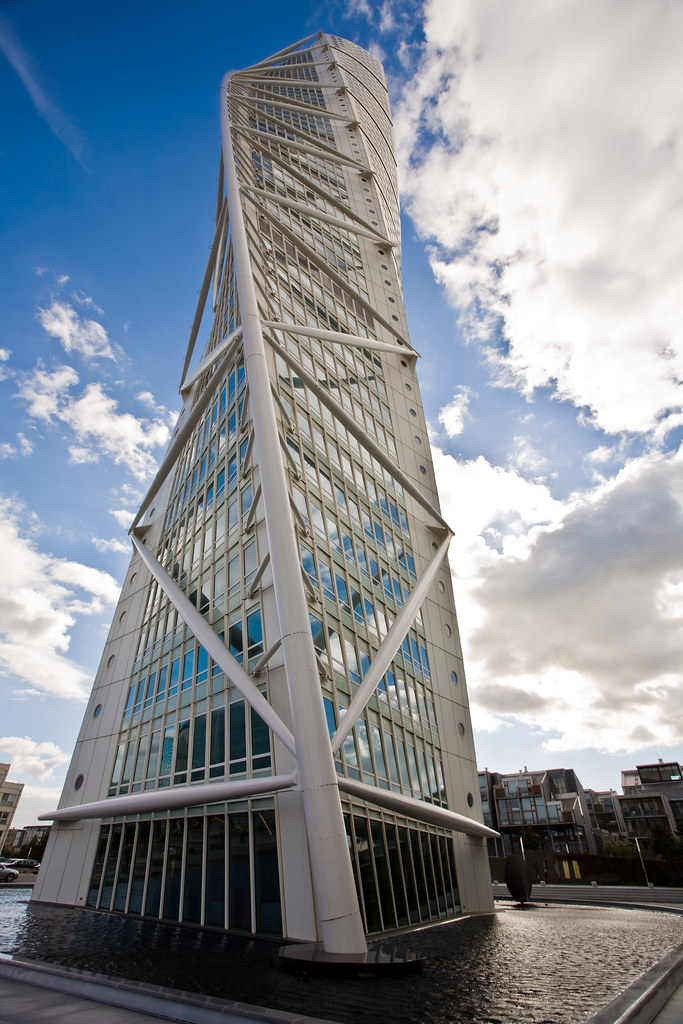
HSB Turning Torso is a skyscraper in Malmö, Sweden, located on the Swedish side of the Öresund strait.

The tower reaches a height of 190 metres (623 feet) with 54 stories. Upon completion, it was the tallest building in Scandinavia, the tallest residential building in the EU and the second tallest residential building in Europe, after the 264-metre (870 ft)-high Triumph-Palace in Moscow. A similar, taller skyscraper featuring the 90˚ twist is the Infinity Tower, currently under construction in Dubai, United Arab Emirates.


The design is based on a sculpture by Calatrava called Twisting Torso. It uses nine segments of five-story pentagons that twist as it rises; the topmost segment is twisted ninety degrees clockwise with respect to the ground floor. Each floor consists of an irregular pentagonal shape rotating around the vertical core, which is supported by an exterior steel framework. The two bottom segments are intended as office space. Segments three to nine house 149 luxury apartments.

The vision of HSB Turning Torso is based on a sculpture called Twisting Torso. Santiago Calatrava, one of the most noticed architects of our time, created HSB Turning Torso with inspiration from the human body in a twisting motion.
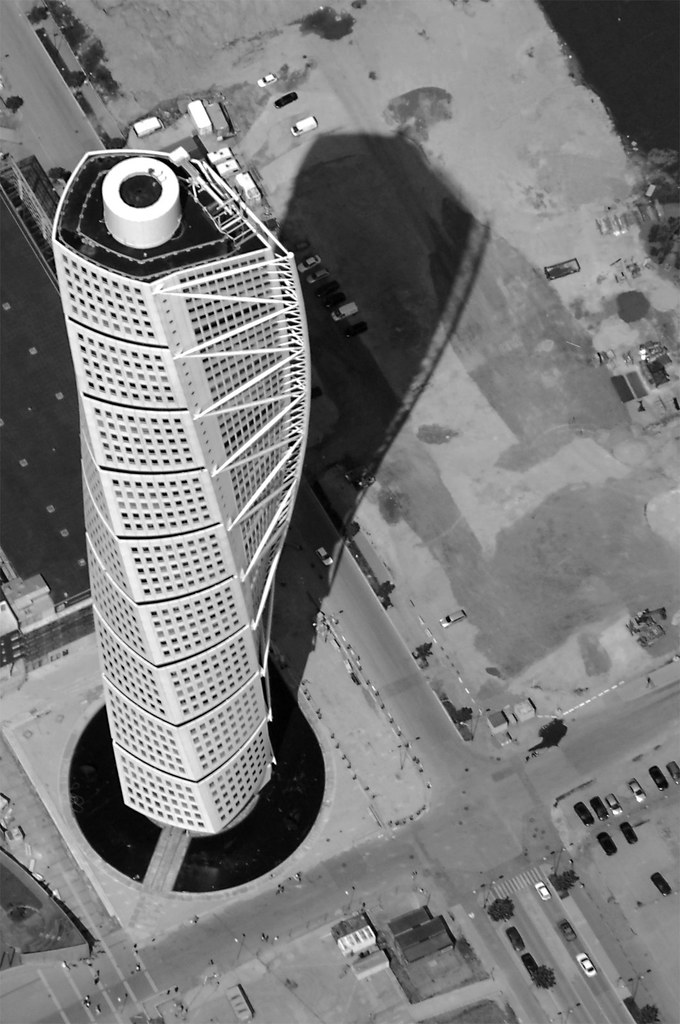
Photo by topherous

In 1999 HSB Malmö’s former Managing Director Johnny Örbäck saw the sculpture in a brochure which presented Santiago Calatrava in connection with his contribution to the architectural competition for the Öresund Bridge. It was on this occasion that Johnny Örbäck got the idea to build HSB Turning Torso. Shortly thereafter he travelled to Zurich to meet with Santiago Calatrava and ask him to design a residential building based on the idea of a structure of twisting cubes – Turning Torso.

HSB Turning Torso is an amazing combination of sculpture and building. It is also one of the few landmarks in the world which becomes part of everyday life with its ten floors of offices, 147 apartments and meeting facilities on the two top floors.
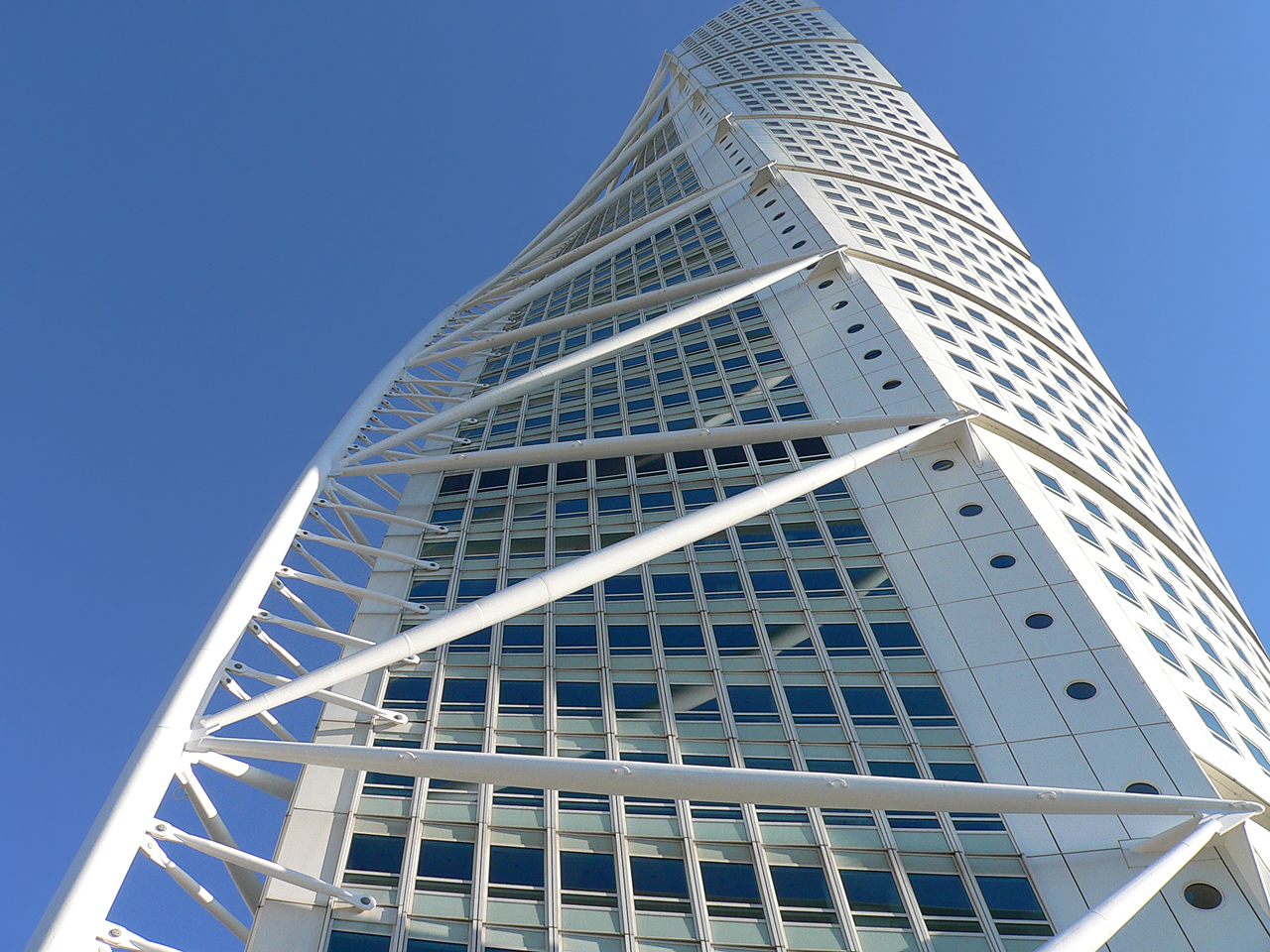


HSB Turning Torso has not only enjoyed interest due to its exciting architecture and living concept, but also due to its complex construction. In an episode of the programme "Extreme Engineering", Discovery Channel focused on the technically advanced nature of the building making a one hour documentary illustrating the challenges the building construction workers have to face.

The foundation of the building is built directly on the limestone bedrock. Profiled steel plates, forming the foundation shaft, were driven 15 metres into the ground and a further 3 metres into the limestone bedrock by an enormous vibrating sheeting machine. Concrete was injected into the soil outside of the steel-encased shaft to reinforce it and seal it against the water-bearing stratums.

Photo by Kristian 08

When the sheeting and concrete injection was complete the shaft was dug out. Concrete beams, so-called hammer braces, were poured at regular intervals on the inside of the sheeting to stabilize the steel lining against the pressure of the soil outside. Concrete was injected into the bottom of the shaft before it was dug out all the way down to the bedrock in order to seal and reinforce it.

Approximately 5100 m3 of concrete went into the foundation and was poured continuously for 3 days and nights at a rate of 100–150 m /h. About 850 lorries transported the concrete. Because of the strict demands on crack reduction the concrete was kept cool during the hardening process. Computer simulations of the whole process ensured that the optimal concrete mix and pouring temperature were found. The entire foundation work up to ground level was completed in June 2002.

Photo by Milton CJ

Read more...

Habitat 67

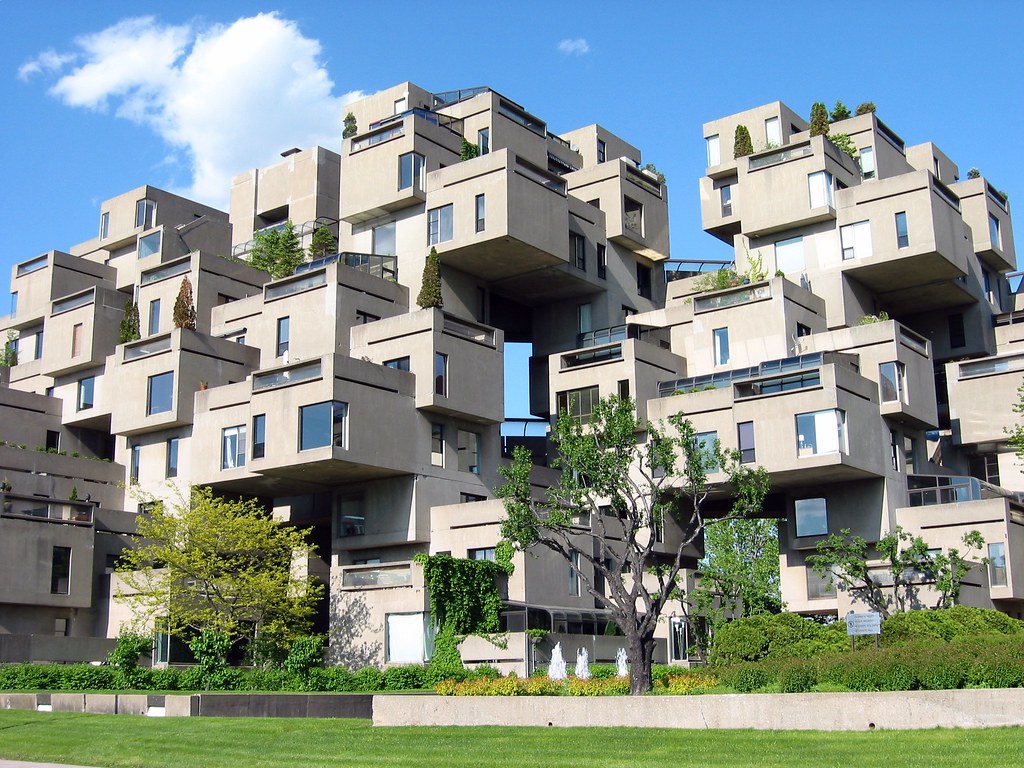
Habitat 67 is a housing complex and landmark located on the Marc-Drouin Quay on the Saint Lawrence River at 2600, Pierre Dupuy Avenue in Montreal, Quebec, Canada. Its design was created by architect Moshe Safdie based on his master's thesis at McGill University and built as part of Expo 67.

Habitat 67 then became a thematic pavilion invaded by thousands of admiring visitors that came from all around the world, on top of being the temporary residence of many dignitaries passing by Montreal.

Photo by rezendi

Habitat 67 was an event in itself at the time. It still is today.
This housing complex became not only the “place where to be” for some 148 singles, couples and families which have made it their main residence, but as well a real community of which the style and the quality of life are envied throughout Canada.

The cube is the base, the mean and the finality of Habitat 67. In its material sense, the cube is a symbol of stability. As for its mystic meaning, the cube is symbol of wisdom, truth, moral perfection, at the origin itself of our civilization.

354 cubes of a magnificent grey-beige build up one on the other to form 146 residences nestled between sky and earth, between city and river, between greenery and light.

Photo by kitreno

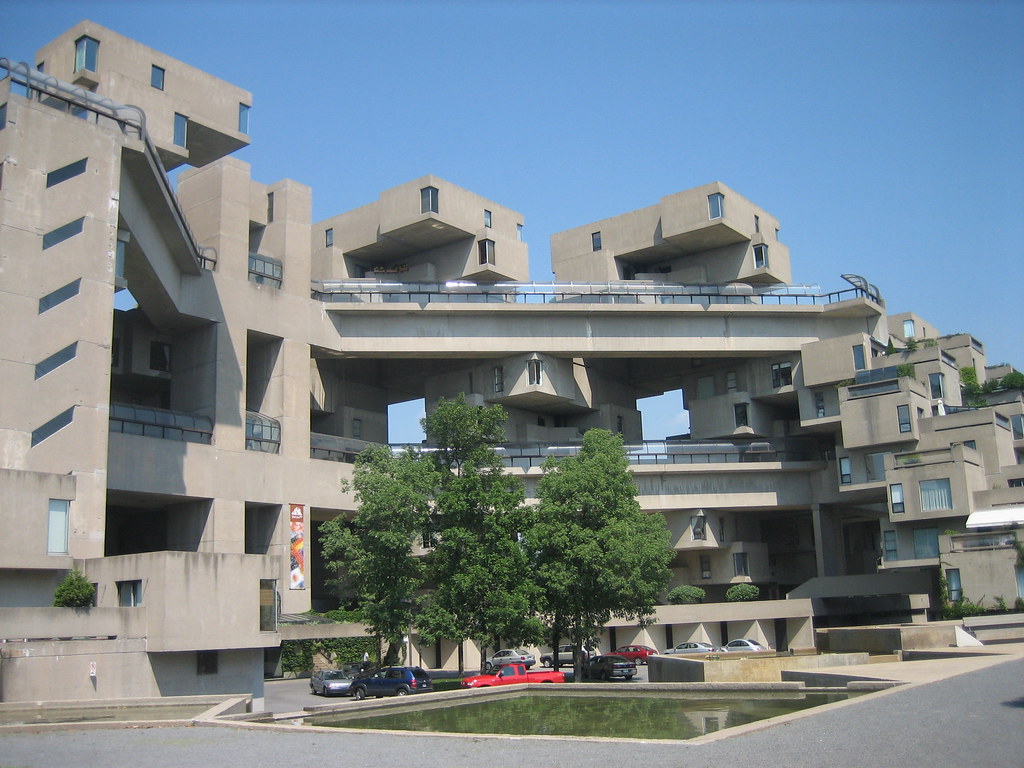
The whole unites in a gigantic sculpture futuristic interiors, links, pedestrian streets and suspended terraces, aerial spaces, skylights of different angles, large plazas and monumental elevator pillars, without forgetting the openings, here and there, that are as many winks and calls to meditation from the environment as well as from the living experience.

Habitat 67’s architect wanted to offer a “fragment of paradise to everyone”.
Habitat 67’s residences characteristics, which are displayed over 12 floors, can be summarized as the following:

- 15 models varying between 1 and 8 cubes
- Views on 3 sides and landscaped terraces
- Areas from 624 to 5000 square feet, displayed over 1,2,3 or 4 floors
- Private terraces from 225 to 1000 square feet
- Possibility to add a solarium
- 6 elevators
- Sidewalks at various levels giving access to residences
- Central heating and air conditioning
- Excellent soundproofing.


Photo by Brian Pirie


Read more...

Tuesday, December 9, 2008

Burj Dubai - "Dubai Tower"

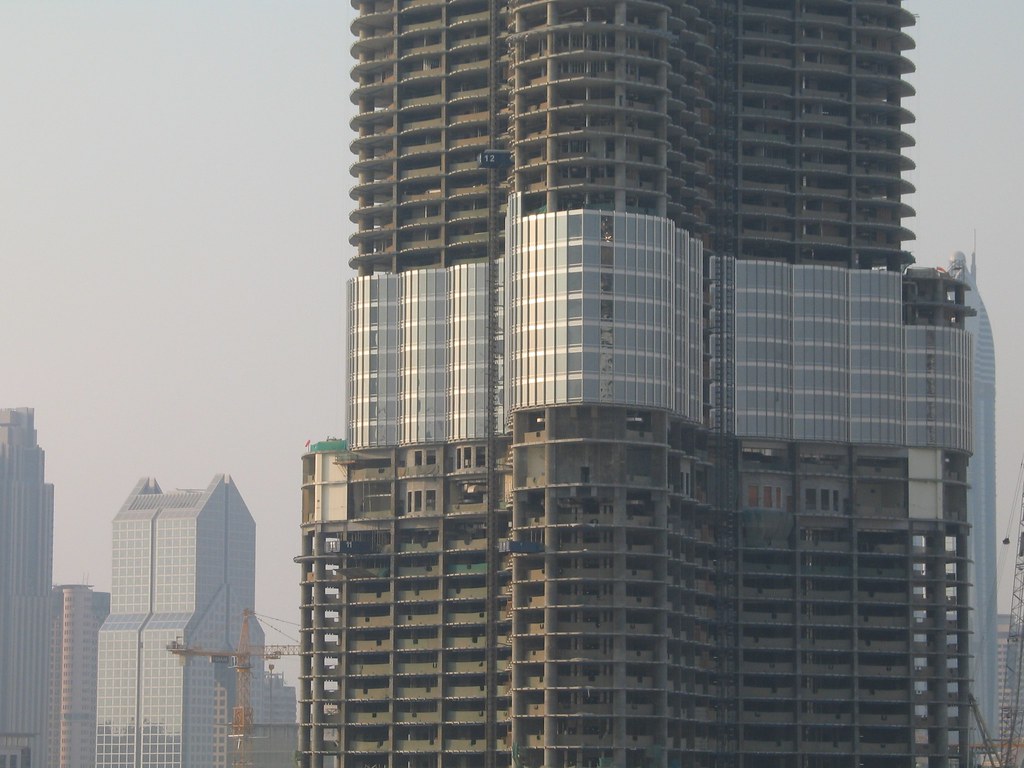
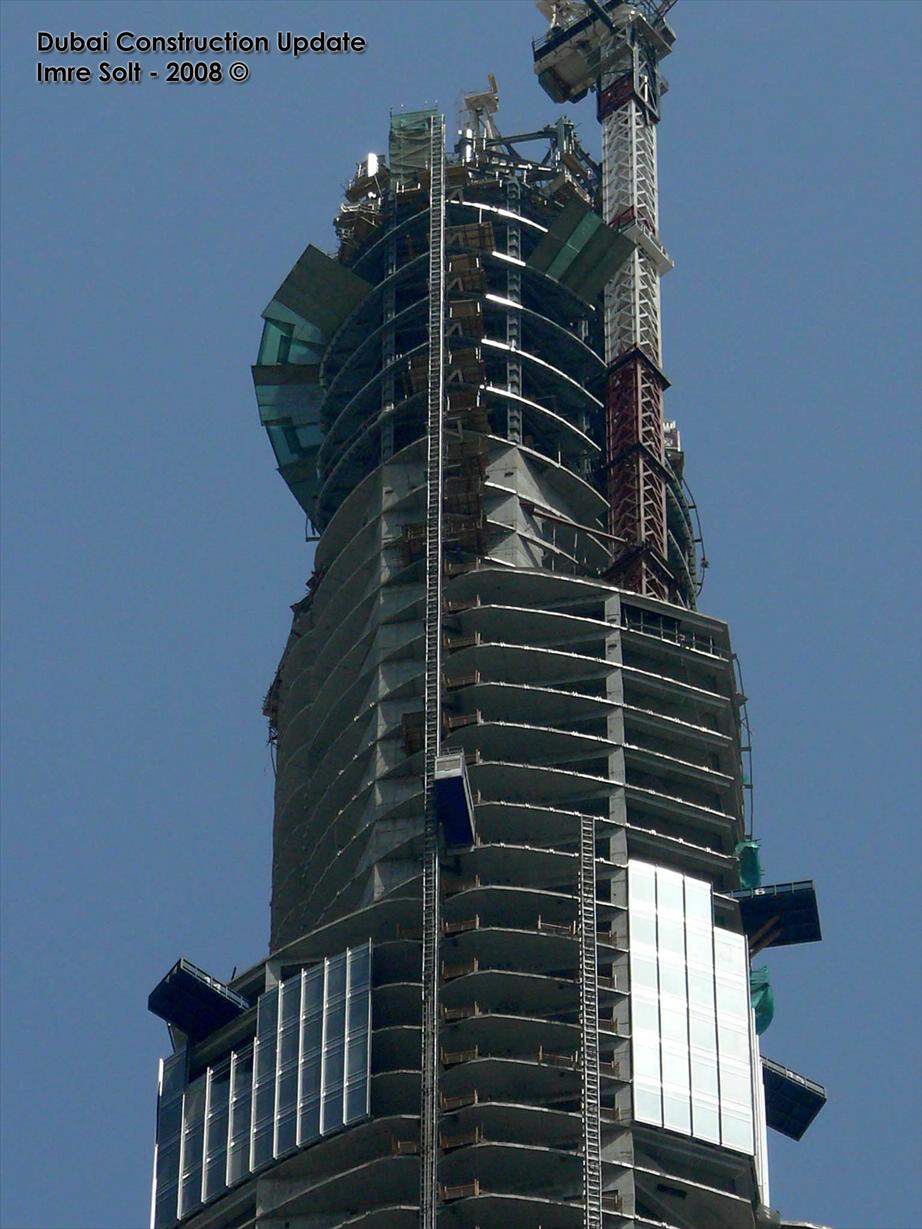
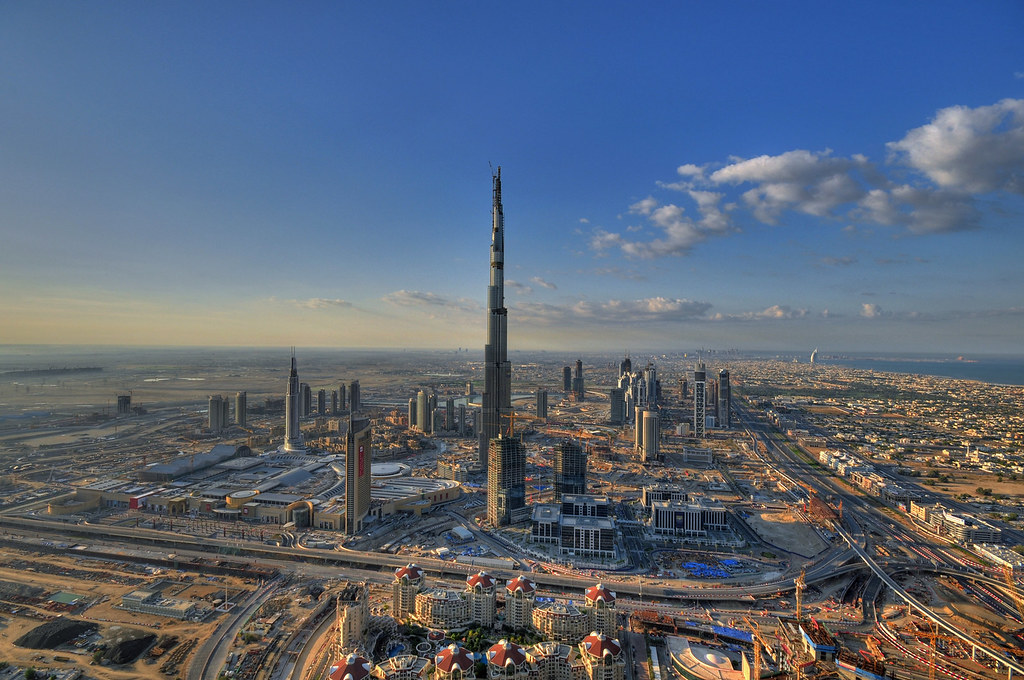
Burj Dubai ("Dubai Tower") is a supertall skyscraper under construction in the Business Bay district of Dubai, United Arab Emirates, and is the tallest man-made structure ever built, despite being incomplete. Construction began on September 21, 2004 and is expected to be completed and ready for occupation in September 2009.

The building is part of the 2 km2 (0.8 sq mi) development called "Downtown Dubai", at the "First Interchange" (aka "Defence Roundabout") along Sheikh Zayed Road at Doha Street. The tower's architect is Adrian Smith who worked with Skidmore, Owings and Merrill (SOM) until 2006. The architecture and engineering firm SOM is in charge of the project. The primary builders are Samsung Engineering & Construction and Besix along with Arabtec. Turner Construction Company was chosen as the construction manager.

The total budget for the Burj Dubai project is about US$4.1 billion and for the entire new 'Downtown Dubai', US$20 billion. Mohamed Ali Alabbar, the CEO of Emaar Properties, speaking at the Council on Tall Buildings and Urban Habitat 8th World Congress, said that the price of office space at Burj Dubai had reached $4,000 per sq ft (over $43,000 per sq m) and that the Armani Residences, also in Burj Dubai, were selling for $3,500 per sq ft (over $37,500 per sq m).


As of September 26, 2008, Burj Dubai had reached a height of 707 m (2,320 ft).

Current records
* Tallest structure: 707 m (2,320 ft) (previously KVLY-TV mast - 628.8 m (2,063 ft))
* Tallest freestanding structure: 707 m (2,320 ft) (previously CN Tower - 553.3 m (1,815 ft))
* Building with most floors: 160 (previously Sears Tower / World Trade Center - 110)
* Highest vertical concrete pumping (for a building): 601 m (1,972 ft) (previously Taipei 101 - 449.2 m (1,474 ft)).
* Highest vertical concrete pumping (for any construction): 601 m (1,972 ft) (previously Riva del Garda Hydroelectric Power Plant - 532 m (1,745 ft).

The projected final height of Burj Dubai is officially being kept a secret due to competition from other buildings under construction or proposed; however, figures released by a contractor on the project have suggested a height of around 818 m (2,684 ft). Based on this height, the total number of habitable floors is expected to be around 162. However, Burj Dubai's construction manager, Greg Sang, has said only that the final height would be greater than 700 m (2,297 ft), a height already exceeded, and that it would be the world's tallest free-standing structure when completed.

The tower is designed by Skidmore, Owings and Merrill, who also designed the Sears Tower in Chicago and the Freedom Tower in New York City, among numerous other famous high-rises. The building resembles the bundled tube form of the Sears Tower, but is not a tube structure. The design of Burj Dubai is reminiscent of the Frank Lloyd Wright vision for The Illinois, a mile high skyscraper designed for Chicago, Illinois. Emaar has also engaged GHD, an international multidisciplinary consulting firm, to assist with the design, review and assessment involved in the construction process.

Photo by Bret Oliver

The design of Burj Dubai is derived from patterning systems embodied in Islamic architecture, with the triple-lobed footprint of the building based on an abstracted version of the flower Hymenocallis. The tower is composed of three elements arranged around a central core. As the tower rises from the flat desert base, setbacks occur at each element in an upward spiralling pattern, decreasing the cross section of the tower as it reaches toward the sky. At the top, the central core emerges and is sculpted to form a finishing spire. A Y-shaped floor plan maximizes views of the Persian Gulf. Viewed from above or from the base, the form also evokes the onion domes of Islamic architecture. During the design process, engineers rotated the building 120 degrees from its original layout to reduce stress from prevailing winds. The tower, at its tallest point, sways a total of 1.2 m (3.9 ft).

The exterior cladding of Burj Dubai will consist of 142,000 m2 (1,528,000 sq ft) of reflective glazing, and aluminium and textured stainless steel spandrel panels with vertical tubular fins. The cladding system is designed to withstand Dubai's extreme summer temperatures. Additionally, at its projected height, the exterior temperature at the top of the building will be noticeably cooler than at its base, by 6 °C (11 °F).

Photo by orbit_77

The interior will be decorated by Giorgio Armani. An Armani Hotel, the first of four by Armani, will occupy the lower 37 floors. Floors 45 through 108 will have 700 private apartments on 64 floors (which, according to the developer, sold out within eight hours of going on sale). An outdoor zero-entry swimming pool will be located on the 78th floor of the tower. Corporate offices and suites will fill most of the remaining floors, except for a 123rd floor lobby and 124th floor (about 440 m (1,444 ft)) indoor/outdoor observation deck. The spire—itself over 200 m (700 ft) tall—will hold communications equipment.

It will also feature the world's fastest elevator, rising and descending at 18 m/s (59 ft/s). The world's current fastest elevator (in the Taipei 101) travels at 16.83 m/s (55.2 ft/s). Engineers had considered installing the world's first triple-decker elevators, but the final design calls for double-deck elevators. A total of 56 elevators will be installed that can each carry 42 people at a time.

Photo by imredubai

The tower is being constructed by a South Korean company, Samsung Engineering&Construction which also built the Petronas Twin Towers and the Taipei 101. Samsung Engineering & Construction is building the tower in a joint venture with Besix from Belgium and Arabtec from UAE. Turner is the Project Manager on the main construction contract.

The primary structural system of Burj Dubai is reinforced concrete. Over 45,000 m3 (58,900 cu yd) of concrete, weighing more than 110,000 tonnes (120,000 ST/110,000 LT) were used to construct the concrete and steel foundation, which features 192 piles buried more than 50 m (164 ft) deep. When completed, Burj Dubai's construction will have used 330,000 m3 (431,600 cu yd) of concrete and 39,000 tonnes (43,000 ST/38,000 LT) of steel rebar (enough to extend over a quarter of the way around the world if laid end-to-end); and construction will have taken 22 million man hours.

As construction of the tower progresses, it becomes increasingly difficult to vertically pump the thousands of cubic metres of concrete that are required. The previous record for pumping concrete on any project was set during the extension of the Riva del Garda Hydroelectric Power Plant in Italy in 1994, when concrete was pumped to a height of 532 m (1,745 ft). Burj Dubai now holds this record as of August 19, 2007, as it has a height of 536.1 m (1,759 ft), to hold the record for concrete pumping on any project; and as of November 8, 2007 concrete was pumped to a delivery height of 601 m (1,972 ft).

Photo by daveandmairi

Special mixes of concrete are made to withstand the extreme pressures of the massive weight of the tower; as typical with reinforced concrete construction, each batch of concrete is tested and checked to see whether it can withstand certain pressures. The head of Concrete Quality Checking on the Burj Dubai project is Alam Feroze, who is in charge of concrete on the whole project. The concrete pumps, pipelines and booms are provided by Putzmeister, of Aichtal, Germany.

The consistency of the concrete on the project is essential. It was difficult to create a concrete that could withstand the thousands of tonnes bearing down on it and also withstand Gulf temperatures that can reach 50 °C (122 °F). To combat this problem, the concrete is not poured during the day. Instead, ice is added to the mixture and it is poured at night when it is cooler and the humidity is higher. A cooler concrete mixture cures evenly throughout and therefore is less likely to set too quickly and crack. Any significant cracks could put the whole project in jeopardy.

Photo by orbit_77

Photo by cdiclerico

Read more...

Friday, December 5, 2008

The Dynamic Tower

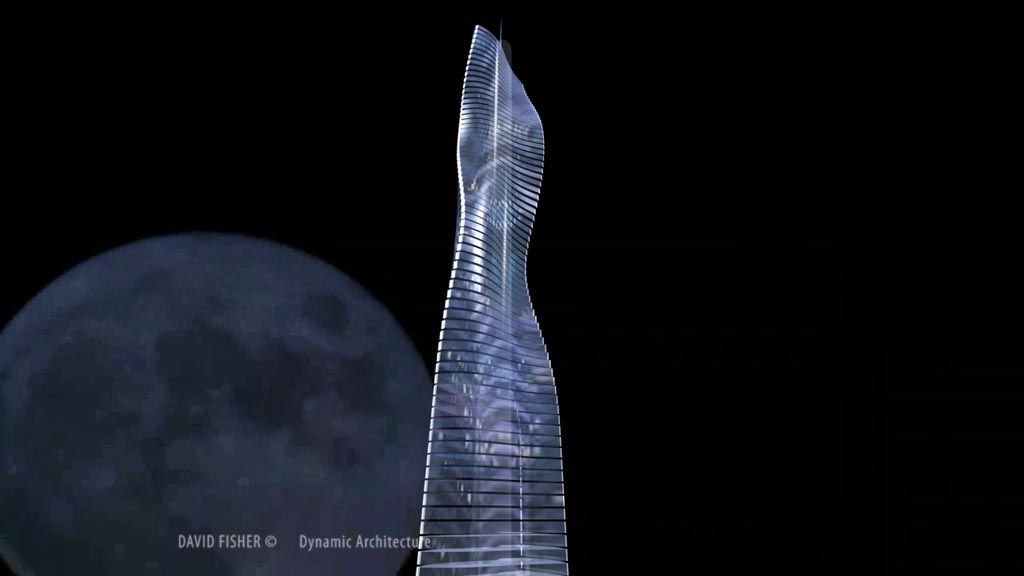
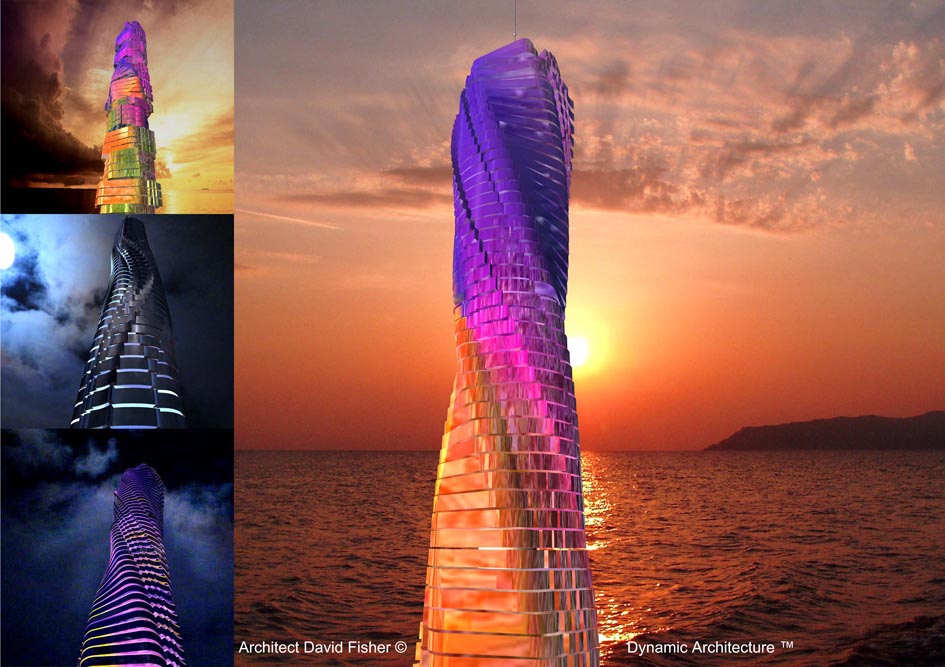
Visionary architect Dr. David Fisher is the creator of the revolutionary Dynamic Tower, the world's first building in motion. The Dynamic Tower heralds a new era of architecture: Buildings in motion will challenge traditional architecture, becoming the symbol of a new philosophy that will change the look of our cities and the concept of living.

The Dynamic Tower offers infinite design possibilities, as each floor rotates independently at different speeds, resulting in a unique and ever evolving shape that introduces a fourth dimension to architecture, Time.

The Dynamic Tower is environmentally friendly, with the ability to generate electricity for itself as well as other buildings nearby making it the first building designed to be self-powered, it achieves this feat with wind turbines fitted between each rotating floor. An 80-story building will have up to 79 wind turbines, making it a true green power plant.

by dynamic-architecture

The Dynamic Tower is also the first skyscraper to be built entirely from prefabricated parts that are custom made in a workshop, resulting of fast construction and of substantial cost savings . this approach known as the Fisher Method, also requires far less workers on construction site while each floor of the building can be completed in only seven days, units can also be customized according to the owners needs and styles.


Dr. Fisher states, “Today's life is dynamic, so the space we are living in should be dynamic as well, adjustable to our needs that change continuously, to our concept of design and to our mood, buildings will follow the rhythms of nature, they will change direction and shape from spring to summer, from sunrise to sunset, and adjust themselves to the weather, buildings will be alive.

“From now on, buildings will have four dimensions, the fourth dimension is ‘Time' to become part of architecture,” Dr. Fisher added. “Buildings in motion will shape the sky line of our cities.

By combining motion, green energy and efficient construction, the Dynamic Tower will change architecture as we know it, and will start a new era of Dynamic Living.


The Dynamic Tower (also known as Dynamic Architecture Building or the Da Vinci Tower) is a proposed 420-metre (1,378 ft), 80-floor tower in Dubai, United Arab Emirates.

The tower is expected to be architecturally innovative for several reasons. Uniquely, each floor will be able to rotate independently. This will result in a constantly changing shape of the tower. Each floor will rotate a maximum of 6 metres (20 ft) per minute, or one full rotation in 90 minutes. It will also be the world's first prefabricated skyscraper. 90% of the tower will be built in a factory and shipped to the construction site. This will allow the entire building to be built in only 18 months. The only part of the tower that will be built at the construction site will be the core. Part of this prefrabrication will be the decrease in cost and number of workers. The total construction time will be more than 30% less than a normal skyscraper of the same size. The majority of the workers will be in factories, where it will be much safer. The entire tower will be powered from turbines and solar panels. Enough surplus electricity should be produced to power five other similar sized buildings in the vicinity. The turbines will be located between each of the rotating floors. They could generate up to 1,200,000 kilowatt-hours of energy. The solar panels will be located on the roof. Construction of the Dynamic Tower, if built, is expected to be completed in 2010.


Read more...

China Central Television (CCTV)

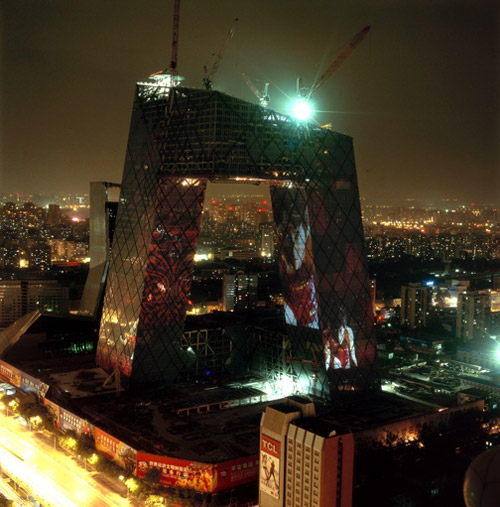
The new headquarters of China Central Television (CCTV) is an iconic anti-skyscraper that, along with other masterpiece designs delivered in time for the 2008 Beijing Olympics, has changed the architectural image of China's capital. The façade of the leaning, conjoined towers was completed before the Games, for which CCTV was the official broadcaster, and a number of spaces inside the building opened to host televised events; however, the building won't be fully realised until 2009.
The building is constructed on a 10ha site adjacent to the Third Ring Road in Beijing, China, in the new Central Business District. The project was started in March 2003 following a review of the design by a panel of Chinese experts. The review was necessary since the ground-breaking design was in contravention to the city's existing building codes.

The development was undertaken by the Chinese Government as part of a plan to redevelop central Beijing with innovative and functional architecture, while preserving historic buildings at the same time.

The new building involves two L-shaped high-rise towers linked at the top and the bottom at an angle to form a loop, which has been described as a 'Z' criss-cross (other local descriptions include calling it a twisted doughnut and also 'the pants'). The linking level features 4m-wide glass floors allowing visitors to peer down to a 162m drop below their feet. Adjacent to the 'loop' is an additional tower, called the Television Cultural Centre (TVCC). The total construction cost of both buildings has been estimated at €850m ($1.2bn). The CCTV tower will employ 10,000 people following its completion and will allow China State Television to broadcast 200 channels (previously they were limited to 16 channels).

Photo by treatzone (m)

CCTV building dimensions

The CCTV building has 465,000m² of floor space. Administration will be allocated 75,000m²; programme offices 65,000m²; news production 70,000m0²; broadcasting 40,000m²; programme production 120,000m²; staff facilities 30,000m² and parking 65,000m². The tower is 234m high (54 floors) and has a footprint of 40m by 60m (2,400m²). The basement reaches 18m (four floors) underground.

The overhanging section expands from nine storeys at one end to 13 storeys at the other, with the bottom floor suspended 162m above ground.

The base section of the 'loop' is 45m high (nine floors) with a building footprint of 160m by 160m;, plus the overhang.

The TVCC building has a total of 95,000m² of floor space, with the luxury Mandarin Oriental hotel occupying 52,000m²; public facilities 23,000m² including a 1,500-seat theatre and a parking facility of 20,000m². This tower is 210m high (44 floors) and has a building footprint of 40m by 52m (2,000m²).
In addition, the service building has 15,000m² of floor space and there is an 85,000m² parking facility.

Structural challenges

The structure of the CCTV building has been a challenge to the engineering contractors Arup. They have had to design a plan to construct the two 6° leaning towers that are bent at 90° at the top and bottom to meet, forming a continuous loop. The building was actually constructed in two tower sections that were then joined to complete the continuous loop on 26 December 2007.

The engineers had to consider the building's stability at each different phase of construction, and designed a braced tube structure to support the leaning towers during their development before they were connected and balanced off each other.

The towers have been constructed at opposite diagonal corners of a 160m × 160m footprint and linked by an L-shaped nine-storey podium with three underground floors. The elements are then co-joined at the top (51 storeys up) by an L-shaped bridge opposite the podium. The tower footprints are 40m × 60m and 52m × 42m. Thin concrete cores inside the building support the internal floors.

CCTV building design

The building was co-designed by Rem Koolhaas and Ole Scheeren of the Office for Metropolitan Architecture (OMA) following a design competition organised by the Beijing International Tendering Company, which ended in December 2002.

The competition was entered by ten companies, including: Dominique Perrault; Kohn Pederson Fox and Skidmore, Owings and Merrill LLP; Toyo Ito & Associates; FCJZ of Beijing; the East China Architecture and Design Institute of Shanghai (ECADI) and OMA.

The international jury, including architect Arata Isozaki and critic Charles Jencks narrowed the competition to three designs, by Toyo Ito & Associates with FCJZ of Beijing, the East China Architecture and Design Institute and OMA, before choosing the OMA design.

On 18 October 2007 OMA were presented with an award at the Cityscape Architecture Review Awards Gala in Dubai for the CC Television headquarters in the mixed-use category.

The lighting designers for the project are LPA of Tokyo. The high rise consultant was DMJMH+N of Los Angeles. The curtain walling was the remit of Front of New York. The broadcast design was a carried out by ECADI and Sandy Brown Associates of London. The acoustics were designed by Dorsser Blesgraaf of Eindhoven, the scenography by DuckS Scéno of France and finally the vertical transportation has been provided by Lerch Bates & Associates of London.


Seismic requirements

There are also strict seismic requirements for Beijing buildings that the design has had to conform to. The building has to have a resistance to intensity 8 with a peak ground acceleration of 0.2g.

Arup has run an advanced non-linear computer simulation, the OASYS Dyna application, to determine the effect of seismic shock on the building's 40,000 structural elements.

Beijing Geotechnical Institute has also collaborated on the earthquake resistance part of the design as well as surveying the site for ground water levels.


Diagrid exoskeleton

A diagrid system 'exoskeleton' was adopted on the external faces of the building to give a tube structure that resists gravity and any other lateral forces. The positioning of the columns and diagonal tubes reflects the distribution of forces in the surface skin of the building.

The columns of the diagrid have the same exposed width but the depth varies according to the load, while the diagonals are all 1m × 60cm plate girders, with only the steel thickness varying. A butterfly plate links perimeter columns, braces and beams.

Read more...

Thursday, December 4, 2008

The Astra Haus

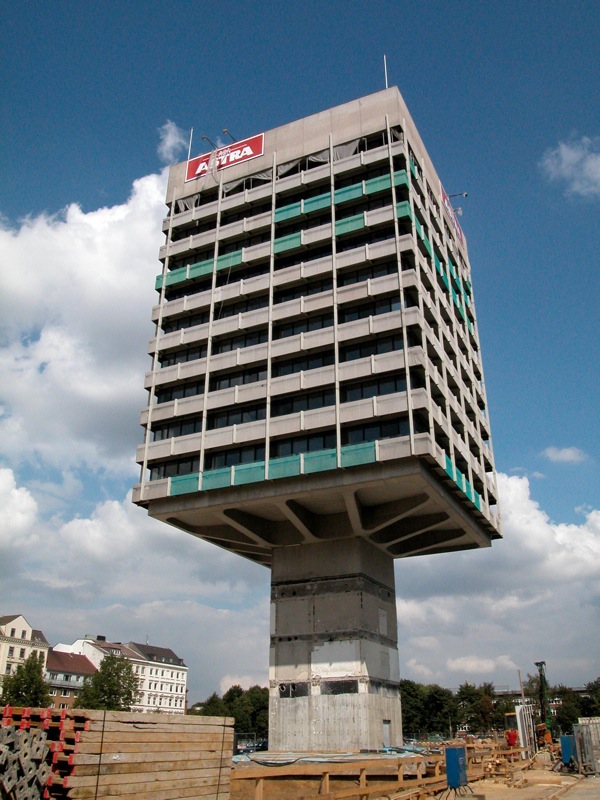
The strange building is actually a brewery in Hamburg, Germany. The floors can move up or down on it's skinny column core. As of now, the unique building has been destroyed. One of it's more famous beer brands was recently bought by a big refreshment corporation. And that beer brand was called Astra.

Photo by hagge2323

Read more...

  © Blogger template Psi by Ourblogtemplates.com 2008

Back to TOP