Showing posts with label Stadiums. Show all posts

Thursday, January 15, 2009

Sapporo Dome

The Sapporo Dome is a stadium located in Toyohira-ku, Sapporo, Japan, and is primarily used for baseball and football. It is the home field of the baseball team Hokkaido Nippon Ham Fighters and the football club Consadole Sapporo.


Hitsujigaoka, where Sapporo Dome is located, is a 40 minute car ride from New Chitose Airport. In Hitsujigaoka stands the statue of Doctor Clark, whose words "Boys, be ambitious!" still influence the people of Hokkaido today. The 31 hectare "Garden of Sports", which has no equal in the world, is located on a beautiful hill surrounded by rich Hokkaido greenery. Sapporo Dome is nicknamed "HIROBA",meaning an open space. In this all-weather supersized dome, many exciting events are held in front of over 40,000 spectators. There is no rain or snow here. There are only dreams. Sapporo Dome,as a new base of sports and entertainment in Hokkaido, and a new tourist spot in Sapporo, will fill the mind of visitors with excitement.

The Dome hosted the opening ceremonies to the 2007 FIS Nordic World Ski Championships on February 22 and hosted the closing ceremonies of the championships on March 4. It also made history as being the first venue where both indoor and nighttime skiing events took place for the first time on a world championship or Winter Olympic Games level with competitions in the cross country skiing sprints (men's and women's individual, and men's and women's team) and the cross country portion of the 7.5 km sprint event in the nordic combined. In order to generate snow, the stadium used its turf conversion hovering system to facilitate the snow making process for the skiing competitions. The opening ceremony featured Maki Ohguro, a local artist from Sapporo, Japanese drum demonstrations and other performances paying tributes to local customs and traditions. For the championships, seating capacity was reduced to 30,000.

Photo by Sasakei

The Dome was used at the 2008 Rally Japan for a super special stage. The Dome is interesting in that it switches between two entirely different surfaces. Baseball games are played on an artificial turf field, while football games are held on a grass pitch that slides into and out of the stadium as needed. Some other stadiums that feature sliding pitches include the Gelredome in the Netherlands, Veltins-Arena in Germany and University of Phoenix Stadium in the United States; however, unlike these three facilities, the Sapporo Dome has a fixed roof.

Conversion from baseball to football begins with the storage of the baseball field's artificial turf. Once finished, a set of lower bowl bleachers rotate from an angled position for baseball to a parallel position. A set of main bowl seats on one end of the dome then retracts, and the football pitch is slid into the stadium. The lower bowl is then rotated 90 degrees. Conversion from football to baseball occurs in reverse.
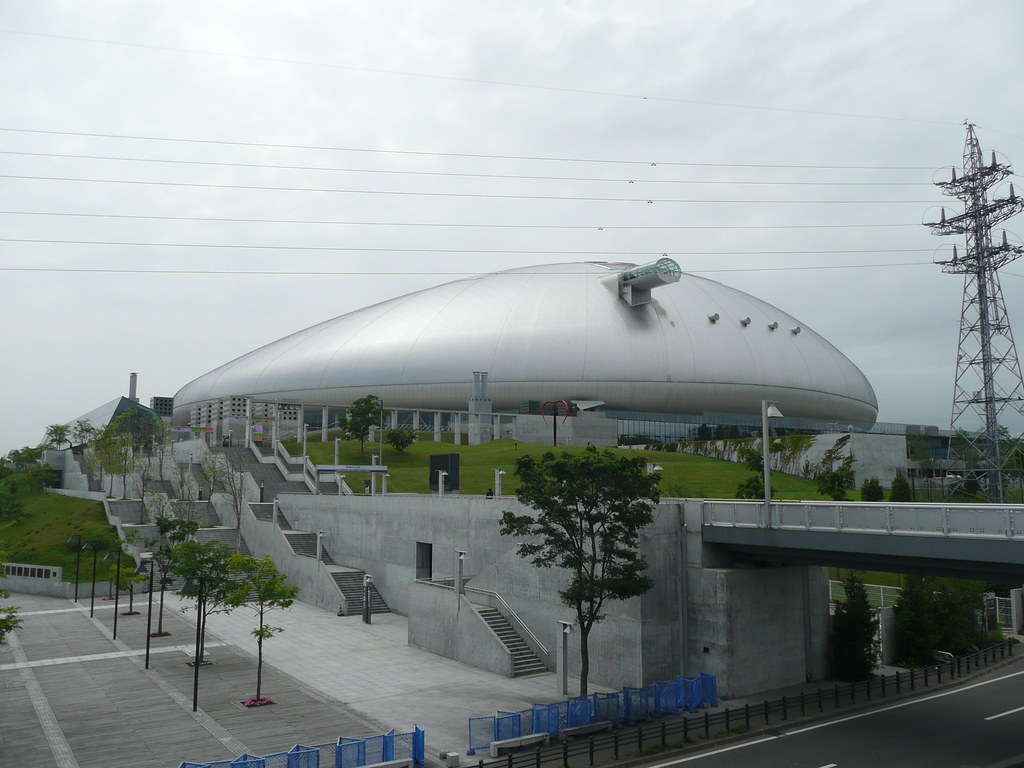
Photo by teikan

Facility Overview

Structure & floors:
Reinforced concrete, steel flame, steel frame ferroconcrete; 4 floors above ground and 2 below ground

Roof:
Fixed shell-shaped roof; Size: longest part: 245m; shortest part: 227m; surface area: 53,000m2

Fields:
Soccer: Mobile natural turf soccer field (Hovering Soccer Stage): 85m in width x 120 m in length
Baseball: Artificial turf; 100m for each wing and 122m for the center

Stands:
Single slope stands (cone-shaped, one-layer type); no. of fixed seats: 41,484; capacity: 53,796

Monitor:
Full-color, large monitor, LED style (7m x 25m); Sub-scoreboard: LED style (2.5m x 13m)

Total construction cost:
42.2 billion yen

Space:
Height: 68 m (from arena surface)
Area: compound area: 305,230m2 ;construction area: 55,168m2 ;total floor area:98,226.21m2; arena area: closed arena: 14,460m2 open arena: 18,800m2
Cubic capacity:1.58 million m3 (closed arena)

Outside facilities:
Parking: 1,351 ordinary vehicles (advance payment for events);bus terminal: 48 berths; taxi stand: 48 taxis; bicycle parking: 206 bicycle and 112 motorcycles
Soccer training ground: 2 fields (including one field with artificial turf)

Facilities for people with disabilities:
Wheelchair seating capacity: 117; toilets: 25 (including 2toilets for ostomates); parking: 50 vehicles; elevators: 11; voice guidance system: 2 locations; Braille blocks.
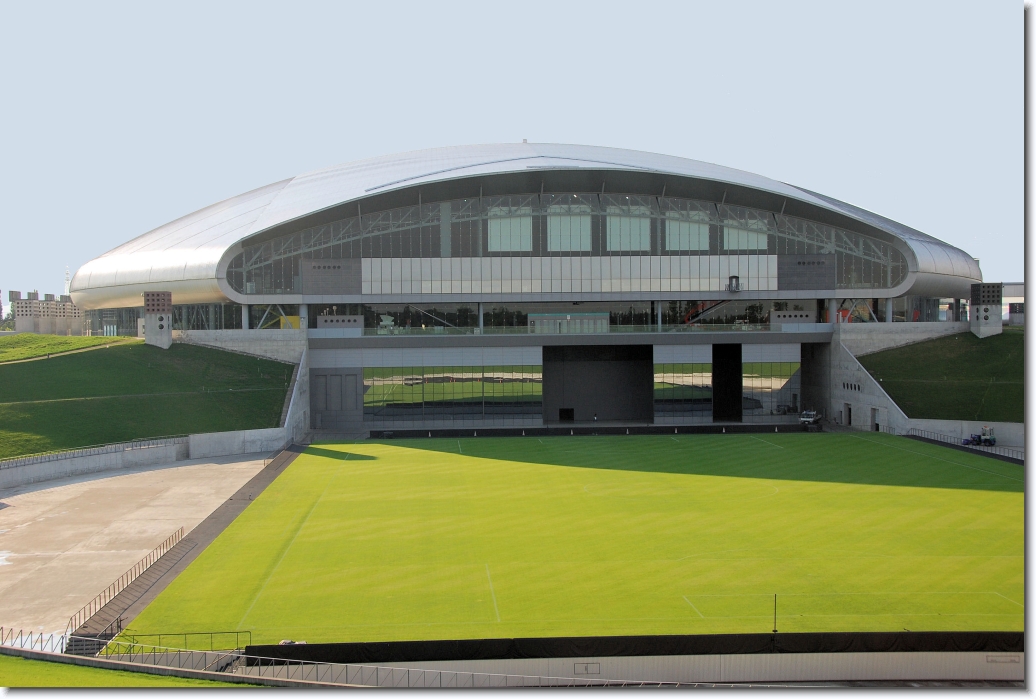
Photo by Tim Kelf

Read more...

Tuesday, December 23, 2008

Allianz Arena

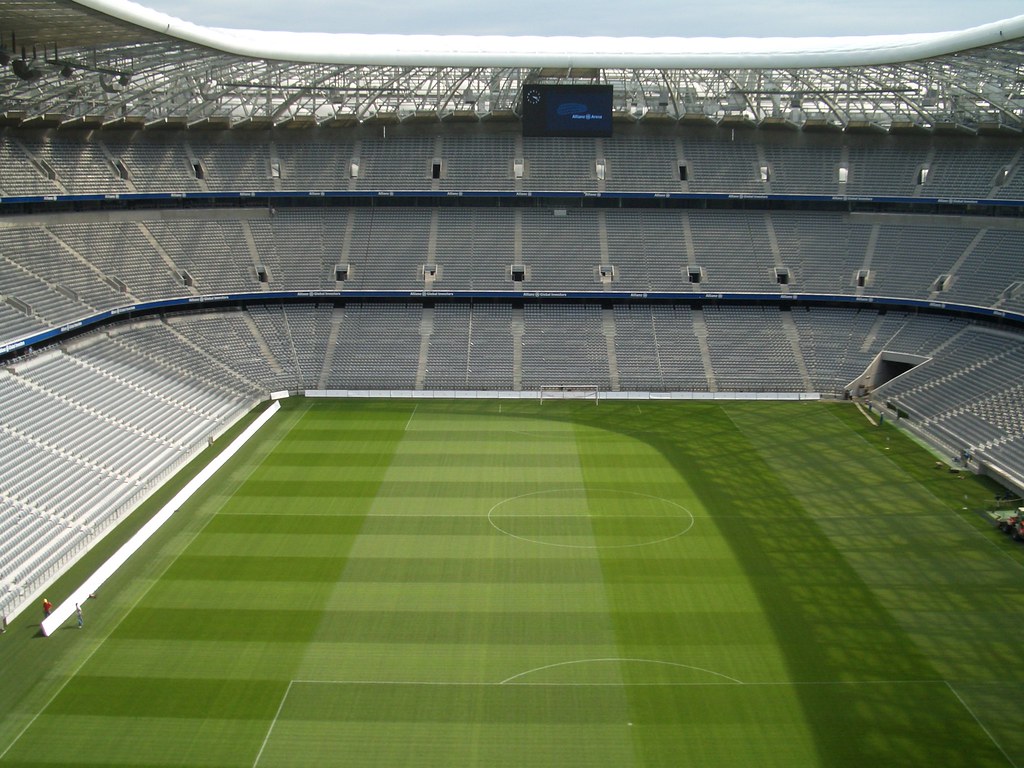
The Allianz Arena is a football stadium in the north of Munich, Germany. The stadium is located at the northern edge of Munich's borough of Schwabing on the Fröttmaning Heath. The two professional Munich football clubs FC Bayern München and TSV 1860 München have played their home games at Allianz Arena since the start of the 2005/06 season. Both clubs had previously played their home games at the Munich Olympic Stadium; FC Bayern München since 1972 and TSV 1860 München since the 1990s.

The winning bid for the Allianz Arena project was made jointly by Alpine Bau Deutschland GmbH and the Swiss architects Herzog and de Meuron. The chosen path is highly innovative, with a futuristic interpretation of the basic football stadium concept. A cascade of colour can be projected onto the smooth lozenge-shaped exterior, which takes the form of a curved translucent shell, infusing the structure with an almost magical poetry. The three-tier seating arrangement guarantees every single one of the 66,000 spectators a close up view of the action, combining raw emotional interaction with all the comforts of a modern stadium.


Capacity
* Total: 69,901 capacity undercover (including.Executive boxes and business seats)
* Total of 66,000 seats
* Lower Tier: 20,000 seats (with standing : 69,901)
* Middle Tier: 24,000 seats
* Upper Tier: 22,000 seats
* in the North and South Stands: 10,400 standing: a relationship of 1-1.3 Vario-Seats
* 2,200 business seats and about 400 seats for the press
* 106 VIP boxes of various sizes accommodating 1,374 guests
* 165 special seats for the disabled at main entrance/exterior ground level (no change of level)


Inside the Arena
6,000 m² of catering facilities devided into following sections:
* 28 kiosks
* 2 fan-restaurants (one in the north- and one in the south-stand), each with 1,000 seats
Restaurant Arena a la Carte accommodating 400 people
Press club with about 350 seats
* Mixed Zone ( 520 m²)
* offices and conference rooms
* comfortably appointed media areas
* a nursery
* 54 ticket counters
* shopping facilities
* changing rooms ( 4 for players: FC Bayern 2, TSV 1860 2 ; 4 for coaches ; 2 for referees)
* 2 warm-up rooms, each 110m²
* 550 WC-cubicles in the Arena
* 190 monitors in the Arena

Photo by plaggenplei


Pitch
* 190 monitors in the Arena
* Total surface (barrier to barrier): 120 m x 83 m
* Spectator distance from pitch: 7.5 m minimum
* Pitchside barrier height: approx 1.2 m

Seat row gradients:
* Lower tier: approx 24°
* Middle tier: approx 30°
* Upper tier: approx 34°
* 2 x 100 m2
LED Video Walls in 16:9 format, 42.5 m above ground
* 232 floodlights, 45 m high

Arena & Esplanade dimensions
Stadium dimensions: 258 m x 227 m x 50 m (gross figure)
* 7 levels
* Admesurement: 840 m
* Façade and roof: 66,500 m² in total, comprising 2,760 inflated panels
* Roof area: 38,000 m²
* Façade: 28,500 m²
* Illuminated area (three colours available); 25,500 m²
* Area occupied by stadium: 37,600 m²
* Total site area: 171,000 m²
Esplanade dimensions: 543 m x 136 m x 0-12 m
* 4 levels
* Admesurement: 1.358 m
* Covered area: approx 73,900 m²

Stadium and Esplanade structure
* Concrete used in stadium: approx. 120,000 m3
* Steel used in stadium: approx. 22,000 t
* Foundations: 180 t, size of a family house, loading up to 1,500 t
* 350 inclined supporting pillars, 50 to each level
* Supporting pillars (cross-section: 65 cm, length: 6 m) have maximum bearing load of 10,000 kN (~1,000 t)
* 8 stairwells, 15 cascade stairways at intervals of 45 m
* External façade (under inflated panels):
* Area: approx. 12,000 m², glazed area: approx. 5,000 m²
* Internal façade (Business Club):
* Area. approx. 350 m², glazed area approx. 300 m²
* Executive boxes:
* Area: approx. 3,000 m2, glazed area: approx. 2,000 m2
* Tiers:
* 2,446 pre-cast elements
* 3,985 stair elements laid on terraces
* 132, 000 drill holes for the 66,000 seats
* Esplanade (4 car parks each on 4 levels):
* Frame construction (supports and bracing beams)
* Floor area: 270,000 m²
* Concrete: 85.000 m³
* Steel: 14.000 t
* Structural steel: 1.400 t
* Promenade (asphalted main connecting level)
* Area: 28,000 m² floor area with 8,50 m ceilings
* 1,033 pre-cast sections on 128 pillars and 88 load bearing points
* External circumference: approx. 1,200 m


Facade
* 2,874 rhomboidal inflated ETFE foil panels form the 66,500 m² roof and façade
* Biggest membrane shell in the world
* Data on the ETFE foil (Ethylene Tetrafluoro-ethylene):
* Thickness: 0.2 mm
* Weight: 350 g/ m²
* Longitudinal/transverse tensile strength: 52/52 N/mm²
* Longitudinal/transverse tensile stress at 10% elongation: 21/21 N/mm²
* Longitudinal/transverse elongation at breaking point: 600/600 %
* UV permability: 95%
* Visible light permability: 93%
* Colour: transparent (roof area), translucent white (rest of façade)
* 1,380 non-standard panels:
* Total area: 7.6 to 40.7 m²
* Length: approx 3 to 10 m
* maximum width: 1.9 to approx. 4.6 m
* Maximum diagonal length: approx 17 m
* Fans keep the panels inflated at a constant pressure of 0.035 bar (maximum possible pressure 0.08 bar)
* In case of snowfall, 12 pressure-monitoring points ensure the correct pressure adjustments to allow for snow up to 1.6 m.
* Lifespan approx 25 years, non-flammable, exceptionally resistant to heat and cold, self-cleans with rain
* 19 panels at the 51.41 m level can be opened to ensure proper ventilation.
* Each of these special hydraulic panels can carry up to 8 t and has a wind pressure resistance of 22 t
* The panels are non-loadbearing

Facade lighting
* 1,056 (of 2,760) illuminated panels (in white, red or blue)
* Total area lit: 25,500 m²
* 4,250 individual lights
* Each panel has 4 identical lights (installed in pairs between two lens shaped panels)
* 25,344 long-life fluorescent tubes with a lifespan of 8,000 hours
* Total power: approx. 1.47 MW
* Each 3.5 m long lamp unit contains 6 long-life fluorescent tubes (58W) and 3 starters
* Red, blue and transparent lenses in each unit allow colour changes
* An asymmetric parabolic mirror ensures uniform illumination of each panel - max. luminance 3000 cd/m²
* Consumption when fully lit: 506 KWh
* Façade lighting required 100 km cabling
* Electricity for the stadium is supplied by 5 transformers
* Lighting changes its colour extend over two minutes to avoid incidents on the motorway
* Allianz Arena logo mounted on north and south sides:
* 12 blue and white illuminated letters each weighing 250-500 kg
* Composition: steel, tin, aluminium, transparent plastic
* Largest LED display in Europe (100,000 individual LEDs)


Roof Structure
* Total area: 38.000 m²
* Primary roof structure (60%):
* 48 radial main beams, approx 65 m long and weighing up to 106 t
* Total of 5,300 t S355 steel
* Secondary roof structure (cross beams, 40%)
* Forms a rhomboidal ‘steel net’ within which the panels are supported
* In the form of rectangular tubing 180 mm x 180 mm x 5-16 mm
* Total of 3,400 t S355 steel
* 50 m high free floating construction
* Maximum load bearing stress, own weight plus full load of snow at centre: 5,000 kN (~ 500 t)
* Maximum load bearing stress at edge: 3,300 kN (~ 300 t)
* Deflection under load at edge with full snow load and wind: 55 cm
* Roof panels have a transparent inner surface
* Retractable internal roof (blind and theatre usage) opened and closed by 51 electric motors

Pitch
* Dimensions: Playing surface 68 m x 105 m, total surface 72 m x 111 m, surface area of 8,000 m²
* Dimensions per lawn-roll: 2.2 m x 15 m
* Weight per lawn-roll: 1.2 t
* Depth per lawn-roll: 30 mm thick "Power Turf"
* Time required: 20 truckloads delivered every hour, on the hour, nine deliveries per day, total approximately two-and-a-half days
* Playing surface: 0.5 % incline towards centre
* Growth: Firm roots in 14 days, initial roots after two days, immediately playable
* Bedding layer: 30-70 cm gravel forming a 4,500 m² frost-free gravel bedding
* Foundations: 10 cm drainage layer (sand), heating pipes, 13 cm lower turf-bearing layer, 9 cm upper turf-bearing layer
* Drainage (seepage pipes): 14 drains each measuring 111 m, 100 mm diameter, total length two kilometres
* Under-soil heating: Pipes 3.2 cm diameter, total length 27 kilometres, three isolated tubes per distributor, manual and automatic temperature control range 35-50 °C, pressure at 1 bar

Hydraulic Pitch Entrance
* Arched zinc galvanised steel construction
* Operation: toggle lever mechanism – Opening travel: 2,300 mm in 11 seconds
* Width at Pitch: 2.50 m
* Height at Pitch: 2.10 m
* Controlled by ‘dead mans handle’ and warning lights in players tunnel
* Additional: emergency exits (swing door) and buffers


Photo by Cr4m0

Dressing Rooms
* Dressing rooms: 65.5 m²
* Massage room: 40.5 m²
* Medical treatment room: 21 m²
* Equipment room: 4.7 m²
* Baths: 2.08 m x 5.16 m x 1 m
* Warm-up area: approx. 110 m2
* Showers: 22 m²
* Coaches' dressing rooms: 40 m²
* Number of lockers: 22
* Number of showers: 12

The stadium was one of the venues for the 2006 FIFA World Cup. However, due to sponsorship contracts, the arena was called FIFA World Cup Stadium Munich during the World Cup.

Read more...

Tuesday, December 9, 2008

Old Trafford

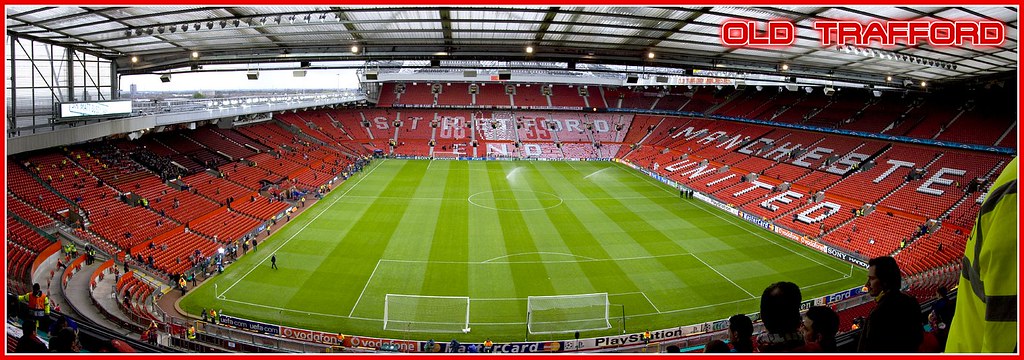
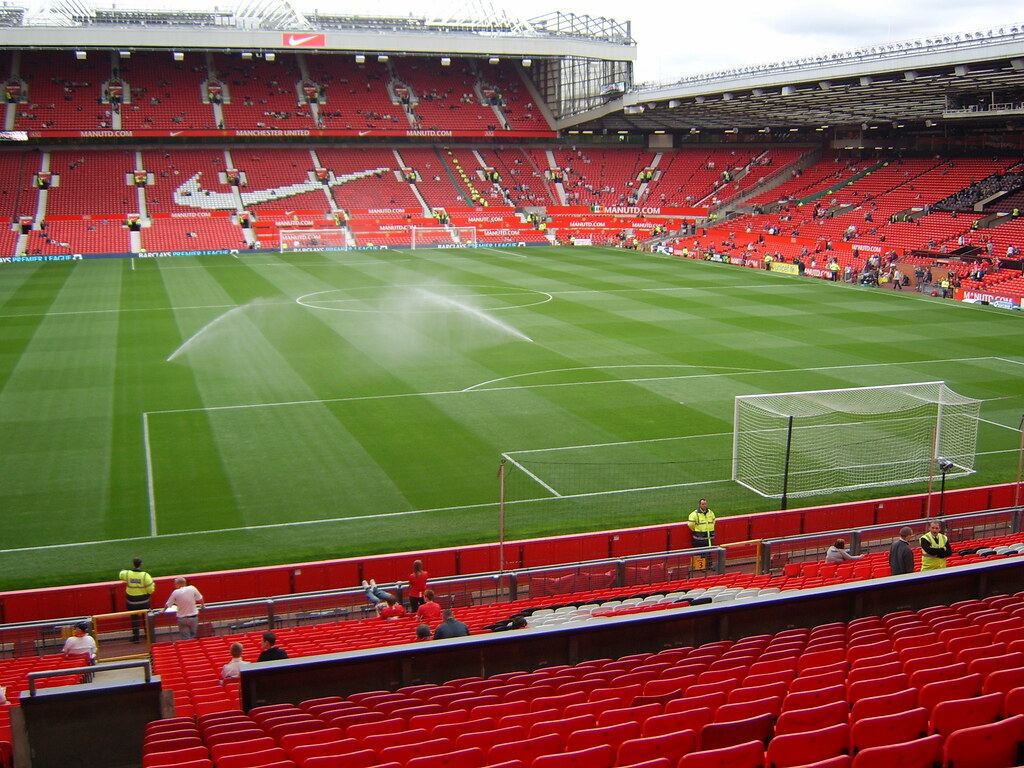
Old Trafford, given the nickname the Theatre of Dreams by Bobby Charlton, is an all-seater football stadium in the Trafford borough of Greater Manchester, England. With space for 76,212 spectators, Old Trafford has the second-largest capacity of any English football stadium after Wembley Stadium and is the only facility in the country to have been given a five-star rating by UEFA. The stadium is approximately 0.5 miles (0.8 km) from Old Trafford Cricket Ground and the adjacent Manchester Metrolink tram station.

Old Trafford was inaugurated in 1910. The stadium was projected by architect Archibald Leitch to host up to 80 000 spectators. The Main Stand was protected by a series of small shelters. The stadium was characterized by large tribunes on every side of the playing field, all connected by closing tiers to create one ring. This continuous ring of tiers was unique in England, because at that time all other English stadiums were characterized by separate tiers with the angles being open.

After the bombings during the Second World War, the stadium was greatly destroyed with some parts of the tiers remaining, as well as the players tunnel that still serves to guide the players to the pitch today. The rest of the stadium was built again in the same shape as designed in the original plans. In 1965 architect Ernest Atherden added a second level of tiers on the North Stand. It was the first time that a stadium contained several balconies. This innovative aspect and the fact that the North Stand contained a large protecting roof, resulted in the stadium to be one of the hosting venues during the 1966 World Cup. Shortly after, a new design led the stadium to be enlarged further.


During the mid nineties, the stadium faced another important series of transformations. All tribunes but the Main Stand were reconstructed and new services such as private boxes, a museum, and the general quarter of Manchester United were added as well.

During the years, the stadium also became the final destination of numerous Red Devils fans - as the typical Manchester United fans are called - whose last wills involved their ashes to be dispersed behind the two doors. The legendary Sir Matt Dusby, memorable trainer of Man United during the fifties and sixties, also found his final destination at the stadium. His statue can be found in front of the main entrance. On February 6th, 1958, seven Man United players were killed in an airplane accident in Munich, Germany. At the inside of the stadium, one can find a clock that stands still at the time the crash happened.


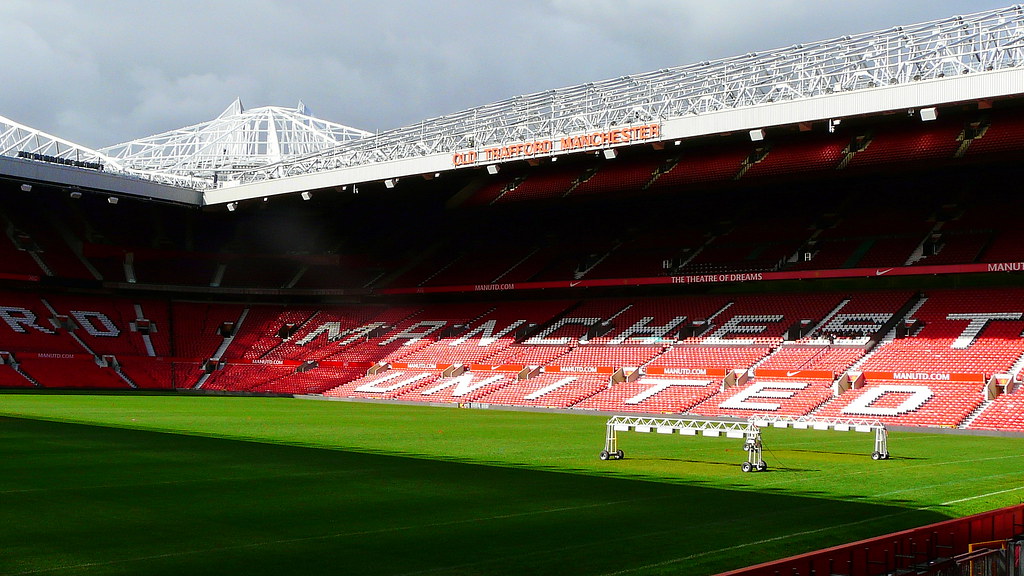
Old Trafford is also called The Theatre of Dreams thank to its fascination, the magical atmosphere around the playing field, also characterized by the red seats as in Red Devils. The exterior of the stadium, on the other hand, has a more anonymous character with large parts of mixed bricks alternated with large windows in Plexiglas and surrounded by an imposing structure in steel that contains rectangular supporting beams to hold the roof. Seen from a little distance, the stadium looks like a gigantic warehouse that emerges between the typical little houses in brick, recalling Manchester's history, one of the first cities affected by the Industrial Revolution.

The Old Trafford pitch is surrounded by four covered all-seater stands, officially known as the North, East, South and West Stands. Each stand has at least two tiers, with the exception of the South Stand, which only has one tier due to construction restrictions. The lower tier of each stand is split into Lower and Upper sections, the Lower sections having been converted from terracing in the early 1990s.

Photo by Dakinho

Formerly known as the United Road stand, the North Stand runs over the top of United Road. The stand is three tiers tall, and can hold about 26,000 spectators, the most of the four stands. The North Stand can also accommodate a few fans in executive boxes. The North Stand opened in its current state in 1996, having previously been a single-tiered stand. As the ground's main stand, the North Stand houses many of the ground's more popular facilities, including the Red Café (a Manchester United theme restaurant/bar) and the Manchester United museum and trophy room. Originally opened in 1986 as the first of its kind in the world, the Manchester United museum was in the South-East corner of the ground until it moved to the redeveloped North Stand in 1998. The museum was opened on 11 April 1998 by Pelé and, according to the club's website, it attracts more than 200,000 visitors every year.

Opposite the North Stand is the South Stand, formerly Old Trafford's main stand. Although only a single-tiered stand, the South Stand contains most of the ground's executive suites, and also plays host to any VIPs who may come to watch the match. Members of the media are seated in the middle of the Upper South Stand to give them the best view of the match. The television gantry is also in the South Stand, so the South Stand is the one that gets shown on television least often. Television studios are located at either end of the South Stand, with the club's in-house television station, MUTV, in the East studio and other television stations, such as the BBC and Sky, in the West studio.

Photo by eucharisto deo

The dugout is in the centre of the South Stand, and is raised above pitch level to give the manager and his coaches an elevated view of the game. Each team's dugout flanks the old players' tunnel, which was used until 1993. The old tunnel is the only remaining part of the original 1910 stadium, having survived the bombing that destroyed much of the stadium during the Second World War. On 6 February 2008, the tunnel was renamed the Munich Tunnel, as a memorial for the 50th anniversary of the 1958 Munich air disaster. The current tunnel is in the South-West corner of the ground, and doubles as an entrance for the emergency services. In the event that large vehicles require access, the seating above the tunnel can be raised by up to 25 feet (7.6 m). The tunnel leads up to the players' dressing room, via the television interview area, and the players' lounge.

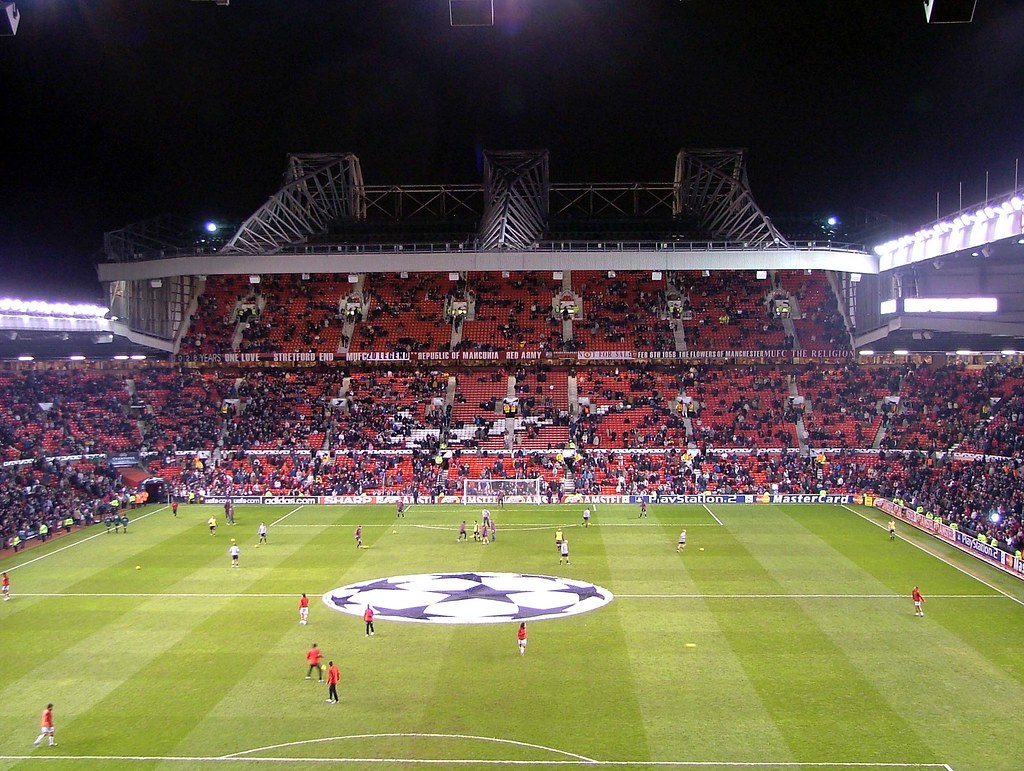
Perhaps the best-known stand at Old Trafford is the West Stand, also known as the Stretford End. Traditionally, the stand is where the hard-core United fans are located, and also the ones who make the most noise. Originally designed to hold 20,000 fans, the Stretford End was the last stand to be covered and also the last remaining all-terraced stand at the ground before the forced upgrade to seating in the early 1990s. The work on the Stretford End, which lasted until July 1993, was carried out by Alfred McAlpine. When the second tier was added to the Stretford End in 2000, many fans from the old "K Stand" moved there, and decided to hang banners and flags from the barrier at the front of the tier. So ingrained in Manchester United culture is the Stretford End, that Denis Law was given the nickname "King of the Stretford End", and there is even a statue of Law on the concourse of the stand's upper tier.

Photo by u_r_slick

The pitch at the ground measures approximately 106 metres (116 yd) long by 69 metres (75 yd) wide, with a few metres of run-off space on each side. The centre of the pitch is actually about nine inches higher than the edges, allowing surface water to run off more easily. As at many modern grounds, 10 inches (25 cm) under the pitch is an underground heating system, composed of 23 miles (37 km) of plastic pipes. Club manager Alex Ferguson often requests that the pitch be relaid, most notably half way through the 1998–99 season, when the team won the Treble, at a cost of about £250,000 each time. The grass at Old Trafford is watered regularly, though less on wet days, and mowed three times a week from April to November and once a week from November to March.

The record attendance recorded at Old Trafford was 76,962 for an FA Cup semi-final between Wolverhampton Wanderers and Grimsby Town on 25 March 1939. However, this was before the ground was converted to an all-seater stadium, allowing many more people to fit into the stadium. Old Trafford's record attendance as an all-seater stadium currently stands at 76,098, set at a Premier League game between Manchester United and Blackburn Rovers on 31 March 2007. This is also the Premier League's record attendance. Old Trafford's record attendance for a non-competitive game is 73,738, set on 1 August 2007 for a pre-season friendly between Manchester United and Internazionale. The lowest recorded attendance at a competitive game at Old Trafford in the post-War era was 11,968, as United beat Fulham 3–0 on 29 April 1950. However, on 7 May 1921, the ground hosted a Second Division match between Stockport County and Leicester City for which the official attendance was just 13. This figure is slightly misleading as the ground also contained more than 20,000 spectators who had stayed behind after the match between Manchester United and Derby County earlier that day.

The highest average attendance at Old Trafford over a league season was 75,826, set in the 2006–07 season. The following season saw the greatest total attendance at Old Trafford, as 2,187,408 people watched Manchester United win the Premier League and the UEFA Champions League, and reach the Sixth Round of the FA Cup. The lowest average attendance at Old Trafford came in the 1930–31 season, when an average of 11,685 spectators watched each game.

Photo by strev87


Read more...

  © Blogger template Psi by Ourblogtemplates.com 2008

Back to TOP